

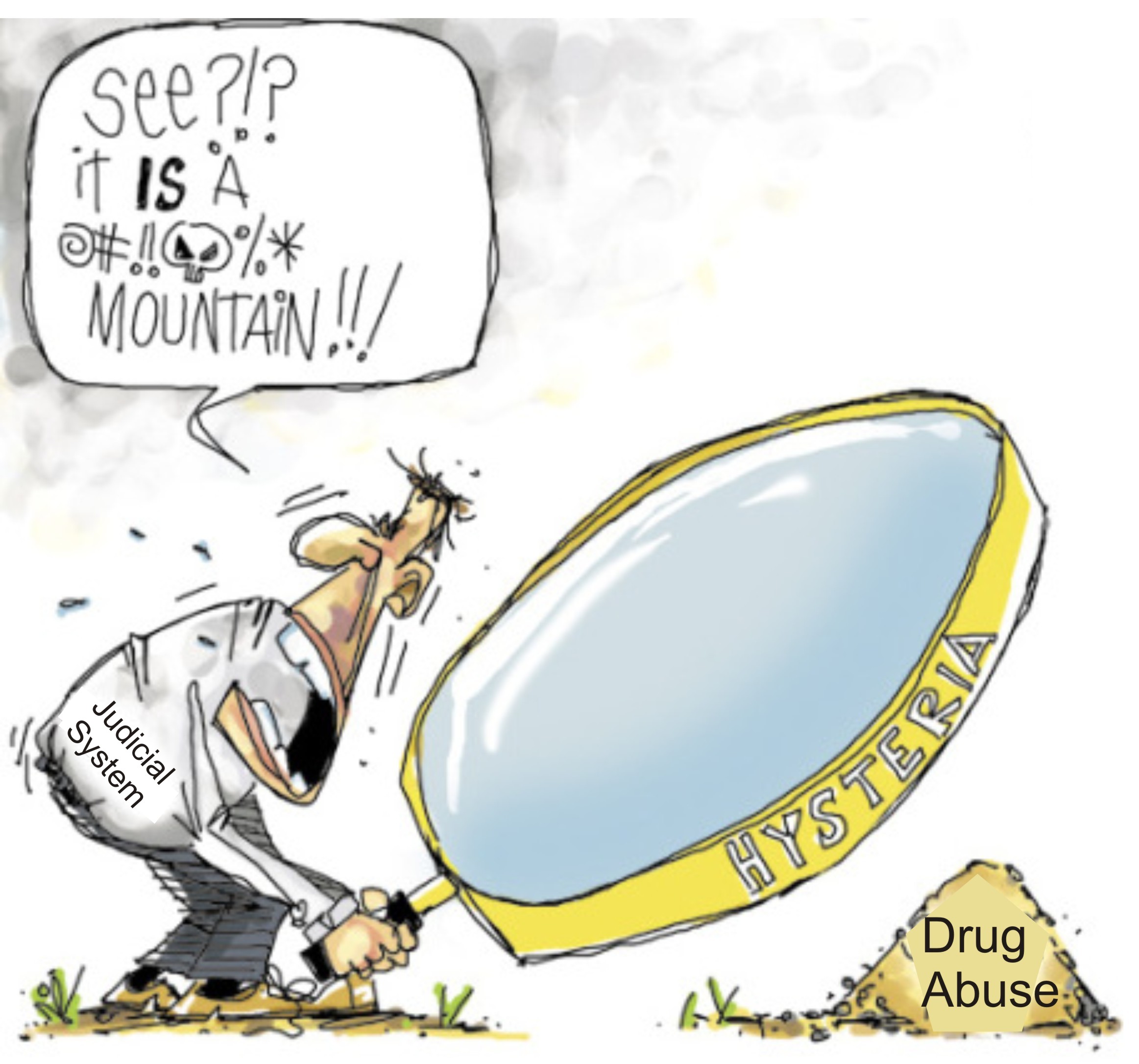
What about BULLET PROOF GLASS and LOCKED DOORS ?

Pharmacy robberies continue; companies acknowledge problem isn’t going away

http://wishtv.com/2015/09/25/pharmacy-robberies-continue-companies-acknowledge-problem-isnt-going-away/

INDIANAPOLIS (WISH) — A spate of a pharmacy robberies in the Indianapolis area this week has renewed concerns about those responsible and the efforts to stop them.

To date, there have been more than 150 pharmacy robberies in the Indianapolis area. This week, there have been seven, which caps off a busy month for authorities.

While police cannot pinpoint an exact cause for the high number of robberies, I-Team 8 has interviewed more than a half dozen law enforcement officials over the past month who have all shared the same theory – that Indiana’s struggle with heroin and prescription narcotics has created a high black market demand for more prescription pills on the streets.

On Thursday, Lawrence Police arrested two suspects – ages 20 and 17 – for an attempted robbery at a Walgreens pharmacy on North Shadeland Ave. Deputy Police Chief Curtis Bigsbee said the same Walgreens store had been targeted two days earlier with an unsuccessful robbery attempt. When a pharmacy tech did not notice the note the suspects were planning to use to demand the drugs, the two suspects left, Bigsbee said.

That’s when authorities set up surveillance thinking the store might be targeted again.

When pharmacy employees noticed two suspects in the store on Thursday, Bigsbee said police were called able to make quick arrests because they were already in the area.

“We were able to find a letter that implied that they wanted certain prescriptions from the pharmacy,” Bigsbee said.

On Tuesday, the Indianapolis Metropolitan Police Department apprehended a 12-year old suspect for allegedly robbing a Walgreens on North Keystone Ave.

This trend of young teens being implicated in pharmacy robberies has led authorities to believe that many of them are being recruited by adults to carry out these crimes – sometimes for a cut of the money gained by selling the prescription pills.

“A lot of these older adults are taking advantage of children to have them act on their behalf. So in some of these cases, they are treated with a lesser crime in juvenile court,” Bigsbee said.

Marion County Juvenile Judge Marilyn Moores acknowledged Friday that she has seen an increase in the number of teenage suspects entering her courtroom charged in connection with pharmacy robberies.

Bren Doyle, a Walgreens customer who agreed to talk to I-Team 8 about her concerns, said she knows it’s a problem.

“I’m a teacher,  so that is just like really mind-blowing that kids that young are already getting involved in that stuff,” Doyle said.

Late last month, CVS installed time-delay safes in an effort to deter additional robberies. Before accessing drugs, pharmacists must first activate the safes which can take several minutes to open. Walgreens installed the safes more than a year ago. A company spokesman, Phil Caruso, told I-Team 8 that in general they have seen some success in reducing pharmacy robberies in the 13 states where they are installed.

But Caruso acknowledged Friday that the robberies are “still an issue.”

“We continue to take this very seriously. We are increasing our security in the stores,” Caruso said.

Bigsbee said he is “concerned” that the time-delay safes might not be discouraging criminals from robbery stores.

Michael DeAngelis, a CVS spokesman, declined to comment when asked about that, saying that the time-delay safes were installed less than a month ago and that “it would be premature for us to comment on an overall trend.”

The prescription is fine.. we just don’t fill this doctor’s prescriptions ?

https://youtu.be/4wulBr6DrhQ

How many boards of pharmacies share with pharmacies who they are investigating about wrong doings ? Suggesting that pts find a new doctor… since the prescriber has not been found guilty of anything.. is that defamation of the prescriber’s good name… isn’t that creating a restraint of trade ?  How much will the damages be.. if the prescriber’s has no charges filed nor found guilty of any wrong doing.  Notice that this Rx dept staff member offers no REAL PROOF of the her accusations about the prescriber’s wrong doing.

Breaking news from SE KENTUCKY

mathillegal

Epidemic of denial of care in Portage Indiana ?

This is my SECOND EMAIL from PORTAGE, INDIANA in the past week… and according to Meijer’s website there is only one store in portage..  Both of these pts have file complaints with the Indiana Board of Pharmacy… I understand that the other one has been referred to the AG office.. but.. we all know how opiophobic Indiana’s AG Greg Zoeller is… will this get any attention ? Apparently the BOP does not consider this at least unprofessional conduct .. which they should have been able to deal with. I have looked up the managing Pharmacist for this Meijer’s and Purdue and Butler are off the hook for training this one.

I went to my local CVS pharmacy (Portage, Indiana) on 9/23/15 where I usually fill all of my prescriptions.  The pharmacist there refused to fill my prescription with no reason or explanation other than she didn’t have to.

After CVS, I went to the Meijer pharmacy at the Portage Indiana location 9/23/15 to have a prescription filled.  The pharmacist refused to fill it.  My prescription is for a medication called Embeda 30/1.2.  I am on this medication for severe back pain caused by herniated discs on both L4 – L5 in my lower back.  The disc is causing pain to radiate through my back, through my buttocks, through my legs, all the way to my feet.  My doctor (a spine specialist in Munster) has tried me on different medications to find a way to relieve the pain.  We have finally accomplished this with Embeda.  The pharmacist told me that he was refusing to fill my prescription and his advice is that I seek a second doctors opinion.  What he failed to realize is that this is the second doctors opinion until I see a spine surgeon on October 6th.  The pharmacist essentially condemned me to live in unnecessary pain with no reason given.  His advice was unwarranted and unwanted.  If he feels that he is in a position to give medical advice perhaps he should go back to medical school and become a doctor.  Or perhaps he could have contacted my doctor to verify that I should have this prescription filled. He was abrupt and cold and sent me on my way.


I have already contacted my doctor this morning to inform him about the issue that no one in my area is willing to fill my prescription.  I have also filed complaints with the US Department of Health and Human Services against each pharmacy, and with the Indiana Board of Pharmacy against each as well.  Are there any other steps that I can take?


Thank you for your time and all of your help,

Indianapolis Physician sues #CVS for defamation

linearoundblockThe line forming to sue CVS ?

CVS Indiana defamation lawsuit
click  on above link for all 39 pages of lawsuit

Besides corporate CVS,  there are FOUR specific CVS stores in central Indiana listed in the suit.

This isn’t your average every day STUPID

advancedstupid

Taxpayers are paying $60 for every pot plant the DEA destroys in Oregon

http://www.washingtonpost.com/news/wonkblog/wp/2015/09/24/taxpayers-are-paying-60-for-every-pot-plant-the-dea-destroys-in-oregon/

The Drug Enforcement Administration spent $960,000 to destroy marijuana plants in that state in 2014 as part of its “Cannabis Eradication Program,” according to a recent report by NBC affiliate KGW in Portland, Ore.

That year, the DEA succeeded in removing 16,067 pot plants from Oregon, which at first blush sounds like a lot of weed. But when you do the math, that works out to a cost to taxpayers of $60 per uprooted plant. That is a lot when you consider that nationally, it costs the DEA *ahem* $4.20 to eliminate a single marijuana plant under this program.

The DEA has budgeted $760,000 in marijuana eradication funds for Oregon this year, according to KGW. Considering that marijuana is now legal in that state, many Oregonians are questioning whether that’s a sensible endeavor — including some members of Congress, who are trying to defund the federal anti-pot program that costs about $18 million a year overall.

The DEA defends the cannabis eradication program on the grounds that much of the marijuana grows it targets in Oregon and elsewhere are the products of Mexican drug cartel activity. “This program has proven effective in dismantling and disrupting drug trafficking organizations,” DEA spokesperson Joseph Moses told KGW.

But some are skeptical, saying that federal authorities may be overstating the connection between Mexican cartels and marijuana operations in the U.S. In 2012, the Office of National Drug Control Policy acknowledged that there wasn’t much hard evidence connecting the cartels to marijuana grows in California. “Based on our intelligence, which includes thousands of cell phone numbers and wiretaps, we haven’t been able to connect anyone to a major cartel,” an ONDCP representative told the Los Angeles Times.

Some law enforcement officials in Oregon are dismantling their marijuana eradication programs, according to KGW’s report. “I want to focus on person crimes,” one sheriff told KGW. “Child abuse, sex assault, crimes against people.”

Marijuana, of course, remains illegal under federal law.

If a picture is worth a 1000 words… what is a TEN MINUTE VIDEO WORTH ?

stevemailboxThis showed up in my inbox…

Florida’s Controlled Substances Standards Subcommittee working to help patients

Group works to solve prescription access problem

Florida’s Controlled Substances Standards Subcommittee working to help patients

http://www.wesh.com/news/group-works-to-solve-prescription-access-problem/35403312

TALLAHASSEE, Fla. —Thousands of pain patients who have had their legitimate prescriptions denied at the pharmacy are one step closer to seeing relief.

Florida’s Controlled Substances Standards Subcommittee is working to solve the crisis that WESH 2 News Investigates has been digging into for the past eight months.

The group is working to help patients to get their needed medication.

In Tallahassee, a subcommittee of the Florida Board of Pharmacy, made up of doctors, pharmacists and one of the largest drug wholesalers in the country, met to tackle the state’s prescription access problem. The group is trying to develop a way for legitimate patients to fill pain prescriptions, from pharmacists who remain hesitant following the state’s pill-mill crackdown.

Special Section: State of Pain

“We are now operating in a time where people are afraid to do their jobs,” said Dr. Jesse Lipnick, with the Florida Medical Association.

WESH 2 News asked Lipnick if the group is confident things will improve for patients.

“I think so,” Lipnick said.

To help make things better, the group is proposing that by the end of 2017, pharmacists should be required to take a two-hour class that would focus on ensuring access for all patients with a valid prescription. That class would be required every two years.

The group is also rewriting a rule that Florida pharmacists must follow to help alleviate concerns, writing in part, “Pharmacists should not fear disciplinary action for dispensing controlled substances for a legitimate medical purpose.”

WESH 2 News spoke with Michael Jackson, with the Florida Pharmacy Association.

“If pharmacists are afraid of the DEA, whether that fear is founded or unfounded, will anything you guys do really make a difference then?” WESH 2 News asked.

“We are not sure,” Jackson said.

Jackson concedes it won’t be an easy fix, but he said they’re committed to trying.

“They just can’t continue to turn away legitimate prescriptions,” Jackson said.

While the subcommittee feels a lot was accomplished, their proposals still hinge on a Florida Board of Pharmacy vote. That could happen in two weeks.

The recommendations will be presented to the Florida Board of Pharmacy at its next meeting Oct. 5 in Tampa.

If you are a Pharmacist in NC/SC

Wigger Law Firm, Inc. - Charleston Personal Injury Attorneys

http://www.wiggerlawfirm.com/

There is a lot going on in the chain pharmacy industry. I got a phone call today about how this law firm who is representing a growing number of Pharmacists in suing a particular every large chain pharmacy/PBM and is looking for more clients. My understanding is that he is taking on these law suits on a contingency basis – no money until you win !

Here are two lawsuits that have already been won by other former employees of this pharmacy chain

http://www.annistonstar.com/news/article_d58128ae-b955-11e4-860b-afeef4fb6ca8.html#.VOfdvgqGJjZ.facebook

http://blog.al.com/spotnews/2013/11/federal_jury_finds_cvs_pharmac.html


What is it called when your boss tell you to stop doing something and you don’t … INSUBORDINATION ?

DEA Still Paying Oregon Cops Top Dollar to Destroy Marijuana Farms

http://www.hightimes.com/read/dea-still-paying-oregon-cops-top-dollar-destroy-marijuana-farms

Both President Obama and AG Holder has told the DEA to stop enforcing the FED MJ laws in those states where it is now legal.. but.. apparently the DEA has its own agenda.  The last time I looked at the command structure of our Federal Government.. the President is technically the BOSS over the AG and the AG is the BOSS over the DEA..  But with all the stuff coming to light about the DEA over the last couple of years.. they seem to believe that they are their own authority and has to answer to NO ONE BUT THEMSELVES …

Although there has been a total repeal of marijuana prohibition in the state of Oregon, a recent report has found that the federal government is still sending the state’s law enforcement well over a half million dollars to be used in the uprooting of cannabis plants.

According to documents obtained by KGW-TV, the U.S. Drug Enforcement Administration will pay $750,000 to Oregon police this year to continue busting marijuana operations all over the state. This compensation—aimed at thwarting the moonshiners of the cannabis trade—is all part of the DEA’s nearly 40-year-old marijuana eradication program.

The problem, however, is that this government agenda is being paid for by taxpayers in states where the voters have determined that weed should be legal. 

“I think the DEA’s marijuana eradication program is a huge waste of federal taxpayer dollars,” Congressman Ted Lieu, a Democrat from California, told KGW. “We have states like Oregon, Washington and Colorado that have legalized marijuana, and then you’ve got the federal government trying to eradicate it. That doesn’t make any sense.” 

Last week, Lieu and his Republican counterpart Justin Amash of Michigan introduced a measure to the U.S. House of Representatives aimed at eliminating the DEA’s $18 million cannabis eradication program. This bipartisan effort would not only prevent this agency from spending tax dollars to destroy a plant that has been legalized in some form in over half the nation, but it would also stop them from cashing in on civil asset forfeitures.

Law enforcement in Oregon will spend the majority of its DEA money flying helicopters over the state in search of cannabis grow sites. Essentially, Uncle Sam is providing them with hundreds of thousands of dollars, courtesy of American taxpayers, to be used for seek and destroy missions against a plant that the majority of the population has said should be legal.

In 2014, these types of drug warrior operations cost Oregon around $275,000 in police overtime and $685,000 for the use of a helicopter—all money that could be spent on anything else now that weed is legal.

However, the DEA argues that the continued funding of the eradication program in necessary in order to fight dastardly domestic drug traffickers and ruthless Mexican cartels that use public land to grow weed for the black market. Yet, in 2014, the program only accounted for the destruction of around 16,000 cannabis plants, which is significantly less than the almost 28,000 they uprooted in 2012. This decline in seized plants is likely attributed to cartels involving themselves in the trafficking of methamphetamine and heroin, while leaving marijuana to the gringos in the legal sector.  

Some police agencies in Oregon agree that federal money is no longer needed for marijuana enforcement. Jackson County Sheriff Corey Falls said that while they once “needed that money… now we don’t.”

Unfortunately, until the DEA is defunded or a substantial federal reform comes down from the top, taxpayers will be forced to finance the snuffing of stoned America—even those taxpayers who adamantly support ending prohibition altogether. Let’s just hope that Lieu and Amash can collect enough support for their legislation to elicit some essential changes to how the DEA spends our money in 2016.

Mike Adams writes for stoners and smut enthusiasts in HIGH TIMES, Playboy’s The Smoking Jacket and Hustler Magazine. You can follow him on Twitter @adamssoup and on Facebook/mikeadams73.