

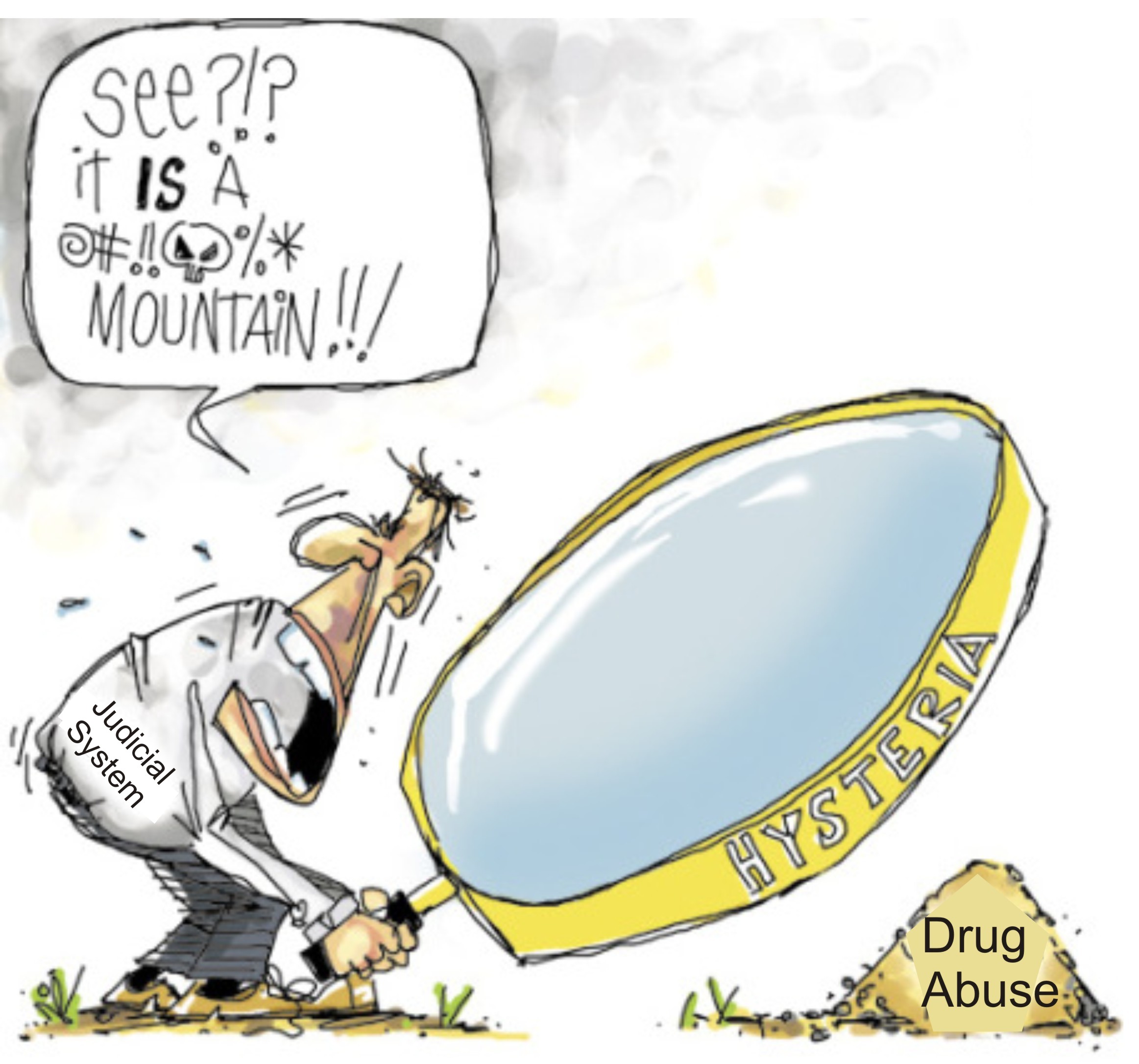
NO MORE ADDICTS … just pts with OPIOID USE DISORDER ?

Medications to treat opioid use disorders: New guideline released

http://www.sciencedaily.com/releases/2015/09/150924124119.htm

Medications play an important role in managing patients with opioid use disorders, but there are not enough physicians with the knowledge and ability to use these often-complex treatments. New evidence-based recommendations on the use of prescription medications for the treatment of opioid addiction are published in the October/November Journal of Addiction Medicine, the official journal of the American Society of Addiction Medicine (ASAM). The journal is published by Wolters Kluwer.

Developed by an expert ASAM Guideline Committee, the National Practice Guideline provides guidance on the use of medications to treat addiction involving opioid use, according to a synopsis by Drs. Kyle Kampman of the University of Pennsylvania School of Medicine, Philadelphia, and Margaret Jarvis of Marworth Alcohol and Chemical Dependency Treatment Center, Waverly, Pa. They write, “This Practice Guideline was developed to assist in the evaluation and treatment of opioid use, and in the hope that, using this tool, more physicians will be able to provide effective treatment.”

Guidance on Using Medications for Treatment of Opioid Use Disorders

Use and misuse of opioids–morphine and related drugs, including prescription pain medications–has risen rapidly in recent years, leading the Centers for Disease Control and Prevention to declare a nationwide “opioid epidemic.” Evidence supports the use of medications, in addition to psychosocial treatments, for people with opioid use disorders.

“Suboptimal treatment has likely contributed to expansion of the epidemic as well as concerns for unethical practices,” Drs. Kampman and Jarvis write. “At the same time, access to competent treatment is profoundly restricted because few physicians are willing and able to provide it.” The skill and time needed for effective use of medications for opioid use disorders “are not generally available to primary care doctors.”

In response, ASAM assembled a multidisciplinary Guideline Committee, consisting of specialists in addiction medicine and other relevant fields. The guideline was developed by a formal process, combining scientific evidence and clinical knowledge. In addition to the synopsis published in the current issue of Journal of Addiction Medicine, the complete guideline can be accessed on the journal website: http://www.journaladdictionmedicine.com.

The National Practice Guideline provides specific recommendations for assessment, diagnosis, and treatment, including the management of opioid withdrawal. It focuses on specific, evidence-based guidance on the major medications used in treating opioid use disorders.

Medication options include the opioid agonist (same action) medication methadone, the opioid partial agonist buprenorphine, and the opioid antagonist naltrexone. The guideline includes recommendations for appropriate use of these medications through each phase of treatment, as well as for patient monitoring and follow-up.

The guideline also addresses the rapid-acting opioid blocker naloxone, which plays a critical role in reversing opioid overdose. The Guideline Committee recommends that first responders such as emergency medical services, police officers, and firefighters be trained in and authorized to use naloxone.

The guideline also includes recommendations for patient populations with special needs and concerns: pregnant women, people with accompanying psychiatric disorders, people with pain, adolescents, and people involved in the criminal justice system. For each area addressed by the National Practice Guideline, the Committee highlights key areas for further research.

Rather than a set of hard-and-fast rules, the guideline is intended as an aid to clinical decision making for professionals at all levels of experience in treating opioid use disorders. Together with the other members of the Guideline Committee and the ASAM leadership, Drs. Kampman and Jarvis hope the information provided will help to make treatment more readily available for people with addiction involving opioid use, thus stemming the tide of overdose deaths.

DEA … CIA/NSA want-a-be’s ? Any of it really legal ?

DEA Operating Surveillance Aircraft Fleet Over U.S. And Abroad

New evidence indicates that the FBI is not the only federal agency using aircraft to conduct surveillance on Americans.

http://www.mintpressnews.com/dea-operating-surveillance-aircraft-fleet-over-u-s-and-abroad/209904/

N1338B - DEA Surveillance Aircraft registered to fake company.

The United States Drug Enforcement Administration (DEA) is operating a fleet of surveillance aircraft over locations within the United States as well as “foreign environments,” according to Jeffrey Stramm special agent in charge of DEA aviation division.

Courtesy John Wiseman

The Administration does not “get warrants for public space surveillance,” Stramm said in a phone call with The Post. He went on to say that this surveillance program is in accordance with Title 21 United States Code.

While Stramm wouldn’t confirm the number of aircraft that make up the fleet, our investigation identified 92 aircraft (as of 2011), much like those belonging to the FBI surveillance fleet. An Office of the Inspector General (OIG) report indicated that the FY2010 budget for DEA aviation operations was $47.6 million. The report also stated that DEA employed 108 Special Agent Pilots as of June 2011.

The DEA surveillance fleet “engage[s] in daily activities,” said Stramm, and “all aviation support requests are initiated by field office supervisors,” according to the OIG report.

The DEA registered 30 aircraft of their fleet to a post office box in Houston, Texas under the corporate name of “Silver Creek Aviation Services,” a company that does not exist beyond registering these aircraft. Another non existent company used for the sake of registering aircraft is “Lindsey Aviation Services,” which houses an additional 10 surveillance aircraft.

This tactic is popular among federal agencies. The FBI registered surveillance aircraft to fake companies such as “FVX Research.” Silver Creek Aviation Services does not appear in Texas public registries or have a web presence beyond aviation registration websites. Stramm explained that registering air assets in this way provides “a level of protection,” against “the bad guys.”

Most of the images of these aircraft show oversized windows which would lend credence to the claim that they are primarily using binoculars and other traditional methods of surveillance and observation. However, while the DEA denies using technology such as the advanced imaging surveillance technology as well as cellphone surveillance technology like StingRay, which is employed by the FBI fleet, photographs of DEA aircraft available online show the same equipment attached to the belly of both agencies aircraft. This advanced imaging technology is capable of monitoring all moving activity, such as cars and pedestrians, within 36 square miles.

The DEA aviation division, unlike that of the FBI, does not allow their aircraft information to be tracked by websites like Flightradar24.com which is used by The Post to ascertain the activities of the FBI fleet and which partially led to the initial discovery in May of this year. By simply requesting either through the Federal Aviation Administration or these public tracking websites themselves, an aircraft owner can block their aircraft from open tracking, as the DEA appears to have done.

The tip that lead to this investigation was from John Wiseman a technologist that, through some techno-sleuthing, tracked a plane registered to Silver Creek Aviation Services despite it’s absence from open flight tracking websites. “I’m picking up mode S/ADS-B pings these aircraft broadcast.” Through this type of tracking Wiseman is usually able to determine aircraft identification, altitude, transponder information as well as location. “I store all the pings in a database so I can go back and ‘hit rewind’ if I learn some new piece of interesting information,” he said. The Post will continue to work with Wiseman on these issues in the future.

One of these aircraft crashed in Westminster, Colorado in January of this year. Local media was intrigued as to why local police rushed out to conceal the tail number of the downed aircraft. It was later made clear that law enforcement and DEA were partners in the mission that ended when the engine of the aircraft failed.

Furthermore, it appears at least one of these aircraft changed hands from U.S. Border Patrol to the DEA. Aircraft N6187Y was deregistered from Border Patrol in 1994 and later registered with DEA. Shifting resources from other national priorities to the War on Drugs is not uncommon.

When asked whether or not these aircraft are used to monitor state sanctioned marijuana activities, the DEA aviation press relations office replied, “not by this office.” This leaves the door open to whether or not surveillance of these activities by field offices is being done with DEA aircraft.

The North Star Post will be submitting Freedom of Information Act requests in order to determine for certain more key details about this domestic and foreign surveillance operation.

Naloxone MAY save hundreds of “frequent flyers'” lives DOZEN OF TIMES ?

Narcan may have saved thousands of lives in NH

http://www.unionleader.com/Narcan-saving-thousands-in-state-

Emergency medical responders have administered more than 2,800 doses of the overdose-reversal drug Narcan in the first eight months of this year, according to state data. The use of the drug each month has doubled over last year’s figures.
In just one six-hour period last Wednesday, Manchester EMTs used Narcan to revive six overdose victims.

Now the state is about to unveil new initiatives to make the drug, also called naloxone, more widely available to addicts, their families and friends.
On Tuesday, Gov. Maggie Hassan and other state officials will announce plans to distribute 4,500 naloxone kits to law enforcement agencies, emergency rooms, community health centers and community groups.
Jake Leon, director of communications for the state Department of Health and Human Services, said the department plans a series of sessions “to train the trainers.”

“Once that’s in place, concerned citizens can then go to these organizations that have the inventory, get trained themselves on how to administer the naloxone and then take it with them,” he said.
The naloxone distributed at these locations will be free of charge.

Meanwhile, pharmacies across New Hampshire are also gearing up to provide Narcan to customers.

The state boards of pharmacy and medicine have been putting together a protocol to allow physicians to write standing orders that pharmacies can use to dispense naloxone to customers without a prescription.
It’s akin to the sort of standing order that lets you walk into a drugstore and get a flu shot or shingles vaccine, explained Michael Dupuis, executive director of the state pharmacy board.

Dupuis said pharmacists here are willing to take on the role of educating customers about the proper use of Narcan for an overdose. “I think they understand how much of a public health concern this is,” he said.
“It’s the right thing to do.”

Leon said with that new protocol in place, individuals who want to have Narcan on hand will have options. “They can go to a pharmacy where there is a standing order already established, or they can go to a provider who will give them a prescription they can then take to the pharmacy to get filled.”
Dupuis said Narcan previously was used in hospital settings for acutely ill patients as part of pain management. Physicians and retail pharmacists had no experience with the drug, he said.

“So it’s a big learning curve for everyone,” he said.
Dr. Seddon Savage, director of the Dartmouth Center on Addiction, Recovery and Education, has been instrumental in developing the state’s new Narcan initiatives. “I think it’s going to save lives,” she said.
Savage, who co-chairs a task force on opioid addiction, has heard the concern that making Narcan more available could encourage some to try heroin, or use more, without fear of overdose. She said that may happen.
“That’s really regrettable, but I think on balance, more lives are going to be saved.”

And she said, “I don’t think that having it not available is going to stop people from using heroin.”

Ann Rice, deputy attorney general, has been working with the medical and pharmacy boards on the naloxone protocols. “A doctor is writing a prescription where there isn’t necessarily a doctor-patient relationship, which is a little unusual,” she said.
Rice said she’s spoken with representatives of retail chain pharmacies, which may not be stocking naloxone yet, but plan to do so once customers request it. “I’ve been assured by the main chains that they are prepared to have it in the stores,” she said.
According to the Chief Medical Examiner’s office, there have been 232 fatal drug overdoses in New Hampshire so far this year; 211 of them involved opiates, including heroin, fentanyl and a combination of the two.
But it’s the naloxone numbers that show the real scope of the epidemic.

In 2014, emergency responders administered 3,275 doses of Narcan in 1,921 separate “events,” according to data compiled by the state Bureau of Emergency Medical Services.
Through August of this year, EMTs already have given 2,813 doses in 1,860 events.

As the state grapples with the opioid epidemic, Savage stressed that Narcan is “an end-stage intervention.”

“What we really want to be doing is reaching people before the point they get to an overdose,” she said.
She’s part of a broad coalition of medical, law enforcement and community groups working on a broad range of responses, such as encouraging primary care physicians to screen patients for addiction, prevention strategies for youngsters and increasing treatment options.
When someone overdoses, there’s a window of opportunity to get that individual into treatment, Savage said. She’d like to see a recovery coach respond to the emergency room every time an overdose occurs, to offer the addict support and treatment options.
Experts say people are beginning to recognize that the opioid epidemic is affecting every community, small towns and large cities alike.

“Whether it’s you or your family member or your community, it’s having an impact on all of us,” said Leon. “So you see more and more communities rising up and taking charge, and the state’s doing the same.
“And I think that coordinated effort is crucial to understanding the issue and finding solutions.”

“There was a time when many Americans didn’t know anybody who’s ever had this problem,” said Savage. “But I think everybody’s family or community or church or social group have been touched by this epidemic, so I think people are beginning to understand.
“It’s coming closer to home.”

Naloxone comes in three forms: intramuscular injection, intranasal and an auto-injector.

The first two cost between $30 and $50, while the auto- injector can cost $500 to $700; some insurance plans cover the drug.
The advantages of the auto-injector are that it’s pre-filled, FDA approved, prevents needle sticks and has audio instructions as soon as it’s activated, according to Savage.
“When people are in crisis and can’t think straight, it tells you exactly what to do – including calling 911,” she said. –

Aren’t those in charge of enforcing the law.. suppose to obey the same laws ?

XXX DEA_POLICE_15963381A.JPG LADEA agents kept jobs despite serious misconduct

http://www.usatoday.com/story/news/2015/09/27/few-dea-agents-fired-misconduct/72805622/

The U.S. Drug Enforcement Administration has allowed its employees to stay on the job despite internal investigations that found they had distributed drugs, lied to the authorities or committed other serious misconduct, newly disclosed records show.

Lawmakers expressed dismay this year that the drug agency had not fired agents who investigators found attended “sex parties” with prostitutes paid with drug cartel money while they were on assignment in Colombia. The Justice Department also opened an inquiry into whether the DEA is able to adequately detect and punish wrongdoing by its agents.

Records from the DEA’s disciplinary files show that was hardly the only instance in which the DEA opted not to fire employees despite apparently serious misconduct.

Of the 50 employees the DEA’s Board of Professional Conduct recommended be fired following misconduct investigations opened since 2010, only 13 were actually terminated, the records show. And the drug agency was forced to take some of them back after a federal appeals board intervened.

In one case listed on an internal log, the review board recommended that an employee be fired for “distribution of drugs,” but a human resources official in charge of meting out discipline imposed a 14-day suspension instead. The log shows officials also opted not to fire employees who falsified official records, had an “improper association with a criminal element” or misused government vehicles, sometimes after drinking.

“If we conducted an investigation, and an employee actually got terminated, I was surprised,” said Carl Pike, a former DEA internal affairs investigator. “I was truly, truly surprised. Like, wow, the system actually got this guy.”

The log, obtained under the Freedom of Information Act, does not include details of misconduct or the agency’s reasons for choosing one punishment over another. But it illustrates just how uncommon it is for DEA employees to lose their jobs because of  misconduct.

“There is a culture of protection internally that has to change. If there’s a bad apple, they need to be fired, if not prosecuted, and that’s just not happening,” said Rep. Jason Chaffetz, R-Utah, the chairman of the House Oversight and Government Reform Committee. “Federal law enforcement should be held to the highest standard.”

At a minimum, Chaffetz said, the DEA and other agencies should be able to sideline troubled agents quickly by taking away their security clearances, a step the drug agency takes infrequently.

The DEA has long faced criticism for how it handles misconduct by its 11,000 employees. This spring, the Justice Department said it had “serious concerns” about the discipline meted out to six agents who left a handcuffed college student in a holding cell for five days with no food or water. Two of the agents received brief suspensions; four others were given letters of reprimand. The student, Daniel Chong, won a $4.1 million settlement.

Years before that, the Justice Department’s inspector general faulted the DEA for imposing “penalties that appear to be too lenient.”

But never has the criticism been more pointed than in March, when the inspector general revealed that DEA agents had attended “sex parties” while posted in Colombia. The agents received suspensions of between two and 10 days. Two weeks later, exasperated lawmakers pressed the DEA’s administrator, Michele Leonhart, on why she hadn’t fired them. Federal law doesn’t allow it, she replied.

“If somebody murdered somebody, could you fire him?” asked Rep. Trey Gowdy, R-S.C.

“If someone murdered someone, there would be criminal charges, and that’s how they would be fired,” she said.

Leonhart resigned a week later. She could not be reached for comment.

Then-Attorney General Eric Holder ordered the Justice Department’s own internal ethics watchdog to conduct a “systematic review” of DEA’s disciplinary process in April. (That office also has faced criticism for being too soft on misconduct.) Spokesman Patrick Rodenbush said the review is ongoing.

The DEA’s internal affairs log shows investigators review more than 200 cases each year and often clear the agents involved. When they do find wrongdoing, the most common outcome is a either a letter of caution — the lightest form of discipline the agency can impose — or a brief unpaid suspension.

In fewer than 6% of those cases did DEA managers recommend firing. In some of those cases, the agency allowed employees to quit. More often, it settled on a lesser punishment.

DEA spokesman Joseph Moses said that often happens because it’s not until after the Board of Professional Conduct makes its recommendations that employees get to fully present their side of the story. That can prompt human resources officials ultimately to opt for lighter punishment.

“DEA agents should be held to a high standard, but not an unrealistically high standard,” said Scott Ando, a former internal affairs investigator for the agency who now heads Chicago’s Independent Police Review Authority. “You can’t expect every agent to get fired for every transgression because they’re people and they sometimes make mistakes.”

The process can also be tedious. DEA records show the agency had not finished some of the misconduct cases it opened in 2011, including two serious enough that the agency’s Board of Professional Conduct recommended the employee be fired.


Even when employees are fired, records show the punishment doesn’t always stick because the agents were reinstated by the federal Merit Systems Protection Board, the independent body that reviews federal disciplinary matters. In one case, the board blocked the DEA from firing an agent who left a voicemail for his girlfriend threatening “to give the couple’s consensually made sex video” to her 8-year-old daughter as a birthday present. It ruled another agent could not be fired after he accidentally fired his gun during a foot chase, then threw away the spent shell casing and told an investigator that the shooting never happened.

“The general feeling throughout senior leadership at DEA was that it’s a ridiculous system,” said James Capra, the former head of operations for the drug agency. “We used to joke that this guy got fired but he’s just going to get his job back.”

Those few who ultimately were fired engaged in what records portray as an array of serious misconduct. Three were ousted after the agency accused them of hiring prostitutes while working in Colombia in 2012, an episode unrelated to the agents who attended sex parties in the country. Two also were accused of lying to investigators. A decade earlier, state prosecutors took the unusual step of indicting one of those agents, Jude Tanella, for manslaughter after he shot a drug suspect in the back as they struggled following a high-speed chase. A federal court threw out the charges because it said a federal agent couldn’t be prosecuted in state court for a justified on-duty shooting.

Tanella’s lawyer, Lawrence Berger, who also represented another of the fired agents, said “it’s a shame that they’ve been treated in such a fashion.”

Another agent, Jeffrey Prather, was fired after admitting he let civilians use “DEA-issued fully automatic weapons” as part of a security training business he had set up, according to merit board records. The board also concluded that Prather, who it said established his own religion, had persuaded “vulnerable and struggling women” to have sex with him “by telling them they would be ‘healed’” if they did.

Prather said the case against him “was a witch hunt.”

Still another agent was fired after admitting that he crashed his government vehicle after a night of drinking and gambling in the Bahamas then repeatedly lied to his supervisors about it. In his defense, the agent told the merit board he was still “under the effects of the alcohol” when he lied to his supervisors in Miami 30 hours later.

drug trafficking ring that obtained more than 80,000 oxycodone pills by way of fraudulent prescriptions.

keystonecopIndictment Charges 9 Individuals with Obtaining Oxycodone in Fraudulent Prescription Scheme

http://www.justice.gov/usao-ct/pr/indictment-charges-9-individuals-obtaining-oxycodone-fraudulent-prescription-scheme

SEP 25 (NEW HAVEN, Conn.) – Michael J. Ferguson Special Agent in Charge of the Drug Enforcement Administration for New England and Deirdre M. Daly United States Attorney for the District of Connecticut announced  that nine individuals have been charged by indictment with participating in a drug trafficking ring that obtained more than 80,000 oxycodone pills by way of fraudulent prescriptions.

“The diversion and trafficking of prescription narcotics is a serious threat to public health, and disrupting criminal organizations involved in this activity and prosecuting those involved  is a priority of the U.S. Attorney’s Office,” said U.S. Attorney Daly.  “I commend the DEA and all the members of the Tactical Diversion Squad for their efforts in this

long-running investigation.”

“The DEA is committed to investigating and bringing to justice those who illicitly distribute oxycodone,” said DEA Special Agent in Charge Ferguson.  “Opiate abuse is a major problem in Connecticut and throughout New England.  The diversion of prescription pain killers, in this case oxycodone, contributes to the widespread abuse of opiates, is the gateway to heroin addiction, and is devastating our communities.  This investigation demonstrates the strength of collaborative law enforcement efforts in Connecticut and our strong partnership with the U.S. Attorney’s Office to aggressively pursue any group that traffics these drugs.”

According to court documents and statements made in court, in 2012, members of the Drug Enforcement Administration’s New Haven Tactical Diversion Squad began an investigation into a drug trafficking organization that manufactured fraudulent prescriptions for oxycodone and distributed the drug in the greater New Haven area.  As part of the conspiracy, members of organization obtained the personal identifying information of medical practitioners and used the information to create fraudulent prescriptions.  Conspiracy members also purchased legitimate prescriptions for oxycodone from individuals.  The organization then used individuals, or “runners,” to fill the fraudulent prescriptions at pharmacies throughout Connecticut.  Once a runner provided his or her personal information to a member of the organization, the runner’s information was kept on file and used to create other fraudulent prescriptions.

Since February 2013, the organization has stolen the personal identifying information of more than 50 doctors and medical professionals and fraudulently obtained more than 80,000 oxycodone pills.
On September 22, 2015, a federal grand jury in New Haven returned a six-count indictment charging the following individuals:

JULIAN CINTRON, a.k.a. “Papi” and Jay,” 36, of New Haven
DAVID THOMPSON, a.k.a. “Super Dave,” 41, of New Haven
ALEJANDRINO DeJESUS, a.k.a. “Baby Boo,” 37, of New Haven
ANGEL MATEO, a.k.a., “Chickyding,” 36, of New Haven
ROBERT WILLIAMS, a.k.a., “Bo,” “Positive” and “Shawn,” 35, of Meriden
LARISSA ARABOLOS, 25, of East Haven
MATTHEW GIGLIETTI, 35, of East Haven
CHRISTOPHER LEVIX, a.k.a. “Scarface,” 33 of New Haven
ANTHONY PALMIERI, a.k.a. “Ant” and “Turtle,” 38, of New Haven
       
As alleged in court documents, Cintron and Thompson have been leaders of the conspiracy since 2013.  Cintron, Thompson and Arabolos manufactured fraudulent oxycodone prescriptions for the organization, and DeJesus, Mateo, Williams, Giglietti and Levix recruited and transported runners.  Palmieri transported runners, and also distributed oxycodone obtained by Cintron and Thompson.
The indictment charges each of the defendants with one count of conspiracy to distribute and to possess with intent to distribute oxycodone, an offense that carries a maximum term of imprisonment of 20 years, and one count of conspiracy to acquire oxycodone by fraud and forgery, an offense that carries a maximum term of imprisonment of four years.

The indictment also charges Thompson with two counts of possession with intent to distribute and distribution of oxycodone, and DeJesus with one count of possession with intent to distribute and distribution of heroin and cocaine, and one count of possession with intent to distribute and distribution of heroin.  Each of these charges carries a maximum term of imprisonment of 20 years.
Cintron, Thompson, Williams, Arabolos, Giglietti, Levix and Palmieri were arrested on federal criminal complaints on September 10, 2015, and DeJesus was arrested on a federal criminal complaint on September 11, 2015.  Mateo currently is in state custody.

The indictment also seeks the forfeiture of $10,207.39 that was seized from Palmieri’s residence on September 10, 2015, and five vehicles owned by several of the defendants.
U.S. Attorney Daly stressed that an indictment is not evidence of guilt.  Charges are only allegations, and each defendant is presumed innocent unless and until proven guilty beyond a reasonable doubt.
The DEA Tactical Diversion Squad includes members from the Greenwich, Shelton, Hamden, Vernon, West Hartford, Bristol and Willimantic Police Departments.


Wonder how many pts have been discriminated against by this Pharmacist ?

Lincoln Co. woman accuses former employer of disability discrimination

http://wvrecord.com/stories/510639824-lincoln-co-woman-accuses-former-employer-of-disability-discrimination

CHARLESTON – A Lincoln County woman has filed suit against her former employers for alleged disability discrimination and other damages.

Rebecca M. Oberman filed suit in Kanawha Circuit Court against Meds 2 Go Express Pharmacy Inc.; and Jeffrey Fulks, Pharm. D.

According to the complaint, Oberman was an employee of Meds 2 Go as a pharmacy technician-in-training from January 2014 until her termination on April 4. Prior to this and during her time at the job, she was being treated for two herniated discs and a pinched nerve. As part of this treatment, she was taking Hydrocodone, which was then switched to Oxycodone in March to be taken at night by her treating physician.

However, Pharmacist, Dr. Fulks allegedly balked at this prescription as being too strong for her and had Oberman tear it up, which she later reported to her doctor, who in turn insisted that the prescription be filled as ordered and called Fulks to that end. Shortly thereafter, Oberman was allegedly terminated because of Fulks did not approve of her using of the drug, a violation of the West Virginia Human Rights Act, as it was a discrimination of her disability.

The plaintiff is citing the defendant for loss of income and benefits, humiliation, embarrassment, mental and emotional distress, loss of dignity, and negligence, and is seeking punitive damages in various areas, including court costs and attorney fees, interest before and after judgement, and any other relief the court sees fit. She seeks a trial by jury.

The plaintiff is being represented by Richard W. Walters of Shaffer & Shaffer PLLC of Charleston. The case has been assigned to Circuit Judge Tod J. Kaufman.

Kanawha County Circuit Court case number 15-C-1433.

Even a blind squirrel will sometimes find a NUT

ADA-Indiana Home Page

http://www.adaindiana.org/

Welcome to our website!  ADA-Indiana is a State Affiliate of the Great Lakes ADA Center, and supported by the Indiana Governor’s Council for People with Disabilities. Our mission is to promote the implementation and voluntary compliance with the Americans with Disabilities Act in Indiana. 

Free ADA Help

If you have a question about your rights or obligations under the Americans with Disabilities Act, call the Great Lakes ADA Center:
(800) 949-4232.

This is for those people who are getting denied their medications in Indiana, other states may have similar groups.


Now they are enforcing laws they can even produce a copy of !

stevemailbox
My husband’s  Dr is in illinois,  pain specialist, had an appt monday september the 21st 2015

dropped off the script on tues 9-22 2015 at CVS north juson IN  they were very behind and busy said pick up for wed 9-23 2015

thurs am Nicole helsel pharmacist called from cvs north judon 9-24-2015 said they will NOT fill the prescription because its an illinois licensed dr and this is indiana

i asked for documentation on that they don’t have any

gave me a number to a cvs district manager andrea who also cant provide me with any proof of law or documentation of this rule/law

we have been filling the same prescription at the same cvs for many months if not yr or yr and a half i have to go to cvs to get a record of filled scripts

husband was in bed for 14 months i had to care for  most of his needs  cleaning feeding helping him get to the washroom table to eat what little he did for fear he had to get up to go use the facilities again

finally found a good dr in illinois after bad experience with an indiana dr

prescription was filled at a different cvs location in indiana

This is strange, for nearly a DECADE, we traveled the country in a motor home and we often had to have prescriptions filled in different states from a Indiana licensed physician… as far away as CALIFORNIA without any problems. Just this past June had a Rx filled in FLORIDA from a INDIANA licensed physician.

This is my THIRD EMAIL in less than a week from Northern Indiana involving CVS or Meijer’s pharmacies/Pharmacists denying to fill Rxs at stores where the pt had been filling the same Rx for a year or more.

TWO DAYS – in the middle of the week – to decide if they were going to fill a Rx or not ???


Why do politicians have to lie, deflect, misdirect ?

https://youtu.be/vfDRy5LakQI

Carly Fiorina claims that she and her husband buried a “child”… when actually it was her step-child and that the “child” was actually a 35 y/o adult ..  That child died of bulimia in combination with “drug abuse” and “alcohol abuse”…  Obviously this “child” had some serious mental health issues, and the definition of “drug abuse” is not explained. Just like the fact that the CDC claims that 44 K die from drug over doses.. yet almost HALF are do to non-prescription medication, and only 16 K can be contributed to legal/illegal opiates and we don’t keep track how many of those 16 K are suicides and not accidental.  IMO… what we need is a lot of  honesty/truth in POLITICS. Let’s cut out all the BULL SHIT. None of the candidates – regardless of political party – are INNOCENT of deception…

They say pain never killed anyone.. WITHDRAWAL however.. is another story.

Man died in ‘excruciating’ pain in jail after staff failed to provide medication, says lawsuit

http://www.independent.co.uk/news/world/americas/man-died-in-excruciating-pain-in-jail-after-staff-failed-to-provide-medication-says-lawsuit-10517363.html

 WHERE IS THE PROTECT AND SERVE ?

The man’s brother has filed a lawsuit alleging neglect

Relatives of a young man who died in police custody after enduring 17 days of agony and torment have sued the authorities and accused them of letting him die by failing to provide his prescribed addiction medication

David Stojcevski was taken to the Macomb County Jail to serve a 30-day sentence for failing to appear in court on a traffic ticket for careless driving. His family say he died 16 days later, having lost 50 lbs in weight and having spent that time naked in his cell – his torment seen on monitor videos.

Robert Ihrie, a lawyer for Mr Stojcevski’s brother, Vladimir Stojcevski, said that what happened to the young man “shocks the conscience.”

The family’s lawyer said the incident ‘shocks the conscience’

“Any case that involves death in a penal institution is hard and sad,” he told the Detroit Free Press. “This case is particularly hard, particularly difficult, particularly sad. It was completely avoidable.”

A lawsuit filed by Mr Stojcevski’s family alleges that officials at the Macomb County jail failed to provide him with the three medications prescribed for him in the months leading up to his incarceration — Xanax, Klonopin and oxycodone.

The first are benzodiazepine medications used to treat anxiety and drug withdrawal, while the third is used for pain relief.

The man’s brother has filed a lawsuit alleging neglect

According to the lawsuit, Mr Stojcevski was recommended for a medical detox unit after he was assessed when he entered the jail in June 2014. On June 17, 2014, he was placed in a mental health cell after a referral noted that he was, among other things, hallucinating and talking to people who were not there.

The lawsuit claims that staff from the jail and the firm Correct Care Solutions, were “deliberately indifferent” to Mr Stojcevski’s mental health and watched him “spend the final 10 days of his life suffering excruciating benzodiazepine withdrawal symptoms”.

Sheriff Anthony Wickersham said he could not comment because the case involved pending litigation. County Corporation Counsel John Schapka said that “knowing the facts and circumstances of the case, I’m confident the county will prevail.”