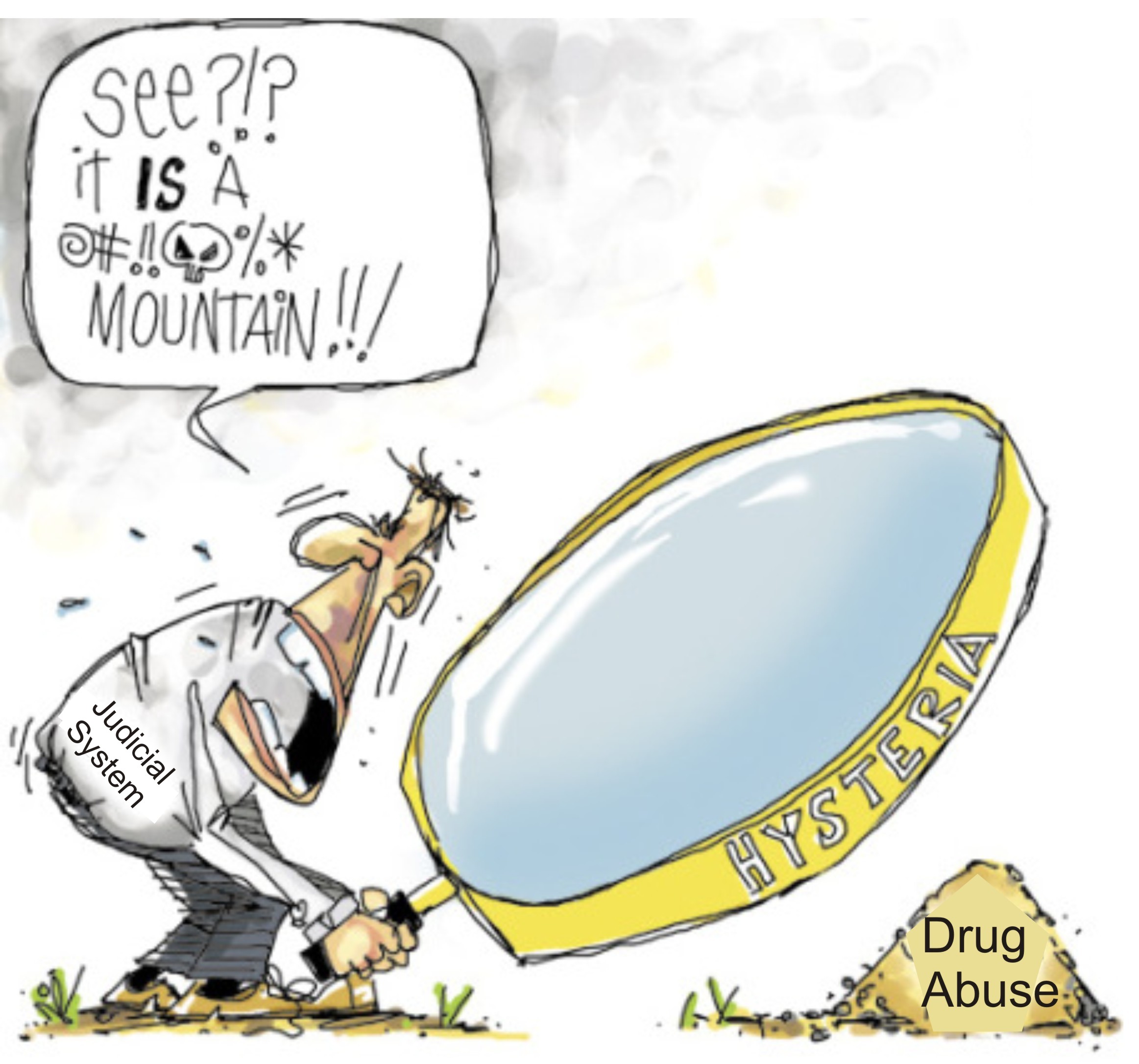
A change in policy.. or just another reason to increase the bureaucracy ?

In heroin fight, White House will push treatment

http://www.washingtonpost.com/politics/in-heroin-fight-white-house-tries-to-break-down-walls-between-public-health-police/2015/08/16/f63d63c2-4425-11e5-8ab4-c73967a143d3_story.html

As heroin overdoses and deaths soar in many parts of the nation, the White House plans to announce Monday an initiative that will for the first time pair public health and law enforcement in an effort to shift the emphasis from punishment to the treatment of addicts.

The experiment, initially funded for one year in 15 states from New England to the D.C. area, will pair drug intelligence officers with public health coordinators to trace where heroin is coming from, how and where it is being laced with a deadly additive, and who is distributing it to street-level dealers.

Two senior officials described the initiative to The Washington Post on the condition of anonymity because the program was not scheduled to be announced until Monday. The new program is a response to a steep increase in heroin use and deaths in much of the nation, especially in New England and some of the other Northeastern states covered in the new program. The death rate from overdoses has quadrupled in the past decade, according to a report from the Centers for Disease Control and Prevention.

From local police to federal law enforcement agencies, two constant frustrations in the battle against the spread of heroin have been an inability to get solid, timely information about where the drug is coming from and who is distributing it, and widespread ignorance among first responders about how to recognize and handle overdoses.

The new effort, proposed by the New York/New Jersey High Intensity Drug Trafficking Area program, one of 28 such federally funded law enforcement initiatives nationwide, seeks to address those problems by hiring 15 drug intelligence officers and 15 health policy analysts who will collect overdose data, find patterns and get intelligence about trafficking trends to street-level law enforcement far more quickly than the current system allows. In addition, the initiative will train first responders on when and how to deploy medication that can reverse opioid overdoses.

David McCarthy was rebuilding his life when he died of a heroin overdose. The Washington Post speaks to McCarthy’s family and friends about his addiction and untimely death at 29. (Alice Li/The Washington Post)

“Our approach needs to be broad and inclusive,” a senior White House official said. “Law enforcement is only one part of what really needs to be a comprehensive public health, public safety approach.”

Twenty-six states have passed overdose-prevention legislation that allows police or fire-and-rescue officers to administer naloxone, which quickly counters the effects of a heroin overdose. The laws also clear the way for people to call for help for an overdosing addict without facing arrest for their own drug use.

nd the Obama administration this year proposed $133 million in new spending to curb overprescription of opioid painkillers, the drugs that have proved to be the primary gateway to heroin use, and to expand the use of suboxone and methadone, drugs that are used as more benign substitutes to wean addicts off the powerful urge to return to heroin.

By comparison, the $2.5 million being committed to the latest program by the White House Office of National Drug Control Policy is a small investment, but a senior law enforcement official involved in developing the new strategy said the pairing of public health workers and police is a key step toward “both reducing crime and reducing the number of people who end up in emergency rooms.”

The new money will pay for hiring “a cop and a health data analyst” in 15 of the nation’s 28 High Intensity Drug Trafficking Areas, which cover about 17 percent of U.S. counties and about 60 percent of the population, the official said.

The new hires will work under a law enforcement coordinator who will use the data to identify targets for police to go after across state lines, and a regional health coordinator who will analyze trends in the overdose data and devise strategies for combating spikes in drug use.

The official said he proposed the initiative to overcome bureaucratic hurdles that make it difficult for information about overdoses and trafficking to cross state lines and get to police in a timely manner.

 “If somebody from Brooklyn is arrested with heroin in Burlington, Vermont, we may not hear about it for months, when that information could allow us to see a trafficking pattern that lets us focus on who to go after,” he said.

Public health data often is not widely distributed for many months, if not years, after the events that originate it. The initiative will allow public health and law enforcement agencies “to see where fentanyl-laced heroin is turning up, in real time, so we can react,” the enforcement official said.

Fentanyl, an opiate that in its legal, prescription form is used to treat post-surgery pain, has been turning up as an additive in the heroin that has caused a growing portion of overdose deaths in recent months.

Heroin is killing people,” the enforcement official said, “and too often, public health goes one way and law enforcement goes the other. Often, grants create silos in government. This program is designed not to create any new agency but to bring people together to break out of those silos.”


Former analyst sentenced for child porn on DEA computer

https://youtu.be/dm6xexu_wJY?t=3m32s

Former analyst sentenced for child porn on DEA computer

http://www.kmbz.com/Former-analyst-sentenced-for-child-porn-on-DEA-com/21866511

KANSAS CITY, KAN. – A former analyst was sentenced Monday to 63 months in federal prison for downloading child pornography to a laptop computer assigned to the Drug Enforcement Administration, U.S. Attorney Barry Grissom said today. Matthew Barnes, 34, Overland Park, Kan., pleaded guilty to one count of possession of child pornography. In his plea, he admitted that on March 21, 2012, a detective with the Overland Park Police was able to download child pornography over the Internet from a laptop computer assigned to Barnes. Investigators determined that the computer was located at the Drug Enforcement Administration’s offices in Overland Park, Kan.

Barnes, who was a member of the Missouri National Guard, was assigned the laptop as part of his work as an analyst with the High Intensity Drug Trafficking Area program.

The National Center for Missing and Exploited Children was able to identify 19 images from nine different known series of child pornography on Barnes’ computer.

You brag about your successes… NOT YOUR FAILURES

Cold-medicine rules pioneered by Oregon curb meth labs

http://www.statesmanjournal.com/story/news/2015/08/16/cold-medicine-rules-pioneered-oregon-curb-meth-labs/31808799/

80% of the meth product found in this country is imported from SOUTH OF THE BOARDER… While the two states have dramatically reduced the number of meth lab busts… there is no mention of the fact of the status of Meth being readily available one the city streets of those two states. Maybe that is because … it has stayed the same or increased.

Oregon’s era of the meth lab is essentially over. The state’s seen a 97 percent decrease in meth lab incidents since the methamphetamine precursor ingredient pseudoephedrine, a nasal decongestant popularly sold as Sudafed, became available only by prescription in 2006. The state experienced 473 meth lab incidents in 2003 and only nine in 2013.

Oregon and Mississippi are the only states requiring a prescription to obtain pseudoephedrine. As of 2013, 63 Missouri cities or counties also have their own prescription-only regulations on pseudoephedrine products. These regulations, the strictest in the nation, have reduced the number of drug labs, according to a report from the Government Accountability Office measuring the impact of state-by-state approaches to curtailing methamphetamine production. The report also notes that although lab seizures are down, Oregon is still a high-trafficking area.

Other states take part in electronic tracking systems like the National Precursor Log Exchange, or NPLEx, which is paid for by pharmaceutical companies manufacturing pseudoephedrine products. Twenty-seven states use NPLEx to monitor how pseudoephedrine passes through their drug stores.

The Drug Enforcement Agency’s El Paso Intelligence Center also maintains the National Clandestine Laboratory Register, where law enforcement agencies report drug lab seizures for a national list. The problem is the register’s entries aren’t necessarily correct or complete. The DEA doesn’t verify the list for accuracy, and law enforcement agencies voluntarily report lab seizures to the DEA.

“Some states tend to be very good at putting information on. Other states, maybe not quite as good,” said Special Agent Joseph Moses, a DEA spokesman in Washington, D.C.

“There could be many more out there that don’t get reported,” said Special Agent Eric Neubauer, a DEA spokesman in El Paso.

gfriedman2@statesmanjournal.com, (503) 399-6653 or on Twitter @gordonrfriedman

Our medical care system – AT ITS WORSE ?


The war on PAIN PTS may never be won…

wethepeople

Those in the bureaucracy has been pushing this war on drug abuse for over a CENTURY. The Joint Commission (JC) made a sizable dent in the denial of care in declaring the 2000-2009 period as the “DECADE OF PAIN”.. declaring pain as the FIFTH VITAL SIGN. When a pt was hospitalized, if  a pt’s pain wasn’t attempted to be properly managed… the hospital’s accreditation with JC  could be placed at risk as well as the hospital’s ability to bill Medicare/Medicaid.

The whole war on drug has been built on a law The Harrison Narcotic Act 1914  The law was influenced by a societal mindset of racism and bigotry and created the black market that the DEA has been fighting a war against for 45 yrs… few would suggest with any success.  At around the same time, our court system determined that opiate addiction was a CRIME..  making it ILLEGAL for prescriber prescribe opiates to addicts – FOR ANY REASON, even though it is well  understood that addiction is a chronic mental health issue.

The early part of our 20th century was considered our PROHIBITIONIST PERIOD.. in 1914 .. the FDA had been around for EIGHT YEARS.. “Snake oil” medicine was still fairly readily available.  the Wright Brothers  had made their first flight just 10 yrs earlier.. women were still  years away from having the right to vote as was alcohol prohibition. The discovery of Penicillin was still 18 years away. It would be 40+ yrs before the first Polio vaccine dose was provided.

Addiction is still a mental health condition and maybe better understood today than 100 yrs ago.  Most addictions are non-violent, victim less situations… should those addictions continue to be a crime and deserve incarceration ?  A alcoholic who stays “three sheets to the wind” in his/her house will most likely never have to deal with the judicial system.. however… drive under the influence and then victims can be involved and people should be held accountable for their decisions/actions.

Should the efforts and resources of those trying to help chronic pain pts get their medications redirect their efforts towards getting the court ruling that addiction is a crime over turned.  If accomplished, all of a sudden the DEA’s hands would be tied on viewing that anyone taking a opiate is a addict/criminal.  It would allow prescriber to treat addicts and chronic painers without concern of consequences.  The DEA can still arrest those diverters/people who sell legal drugs on the street… which is still ILLEGAL..

We have the highest per-cent of our population incarcerated of the civilized world .. the vast majority for non-violent drug crimes.  We are spending 51 billion on this war on drugs.. How much are we spending on supporting families with Medicaid and other governmental aid for the families of these prisoners for non-violent drug offenses ?

How many chronic pain pts could be – with appropriate pain management –  productive, working, tax paying citizens.. not to mention… better spouses and parents. Life.. Liberty.. and the pursue of happiness ?


A video on the history of mental health addiction in Florida

https://youtu.be/wGZEvXNqzkM

This was posted on YOUTUBE.com in Feb, 2014 and it is using stats from 2008 when the pill mills in Florida was a growing crisis and IMO.. the video suggests that it is going on today in Florida..  It is like watching a video/movie on the civil war and think that it is still going on ..  With TWO BROTHERS being addicted.. it would appear that this family’s gene pool has some very serious mental health issues. 

My ONE DAY STAYCATION at our local hospital

Back story.. a few weeks ago .. after doing some weed pulling in the yard.. I experienced some shortness of breath and really not feeling well.. so I when into the house and check my blood pressure… heart rate is 120 + and diastolic is in the low 40’s.. for some reason I was having a HYPOtensive crisis… after some rest everything return to abt “normal range”.. I called my wife’s cardio office for appt.. end up with the “deluxe” stress test package a week later.. everything appeared normal. Go back to see the cardio doc in three weeks..

A few days later .. shortness of breath, chest discomfort.. pressure is 200/100 .. took it several times…  took a shower, got dressed and told Barb that I think that I need to go the ER. I now appear to have a HYPERtensive crisis..

I get to the ER.. keep in mind that this local hospital, a fairly sizable hospital with a lot of cardiac services but was recently listed in a survey of 3000 hospitals by Consumers Report as the 12 WORSE for preventing hospital acquired MRSA & C-DIF… https://www.pharmaciststeve.com/?p=11181

I walk up the ER receptionist and told her my symptoms.. strangely enough… DID NOT get told to take a seat.. but .. COME ON IN.. a nurse took my pressure and it was in the 200/100 range.. my first thought was DAMN my blood pressure cuff is NOT BROKEN …

So into the ER room I go.. attached to automated BP cuff and Oximeter..  they take medication history… no drug allergies.. but told them I was allergic to PEAS, CARROTS, NUTS.. and other medical history..  I am in this room for 3-4 hrs.. and then they decide that they are going to admit me for 24 OBSERVATION … Keep in mind the last time that I was a over night pt in a hospital was SIXTY-ONE YEARS AGO and I was being admitted to one of the worse hospitals in preventing hospital acquired MRSA & C-DIF ..

So off I go to the “observation room” .. the ER nurse stated that she had ordered me a dinner meal for me and to expect it to be there about 5:30… I go to the room .. I have my Ipad and Iphone with me and getting ready to go surf the internet.. they tell me that the hospital’s internet system is down..  no problem.. I will just turn on the “hot spot” on my Iphone and everything will be good… the ATT IPhone .. has no service.. no phone, no text, no internet.. WTH ???  Come to find out.. some idiot has cut a MAJOR fiber optic line in western KY and some MAJOR CITIES in the midwest – had no ATT service..   So now I am have not only having a hypertensive crisis but now also internet WITHDRAWAL … In a hospital where I might acquire MRSA and/or C-DIF..

Abt 06:15 PM.. no meal.. so I buzz the nurse and inquire about my meal… she will check on it… 15-20 minutes later my meal arrives and as I lift the dome off of the food what to I find but some sort of shredded pot roast and a large pile of PEAS… &  large pile of  CARROTS and Cauliflower … Please note FOOD ALLERGIES !!!

I call the attention to the nurse about the error in my meal vs my allergies.. she says the kitchen closes in 15 minutes.. let me see what I can do..  she returns shortly with a small bowl of mashed potatoes and gravy …  and asks.. “do you think that will be enough”.. the only thing I had had all day was a soda and a pack of peanut butter and crackers…  She said that she had “boxed” turkey sandwich they had in the unit frig..  so cold turkey/bread sandwich and a bag of potato chips.. at least it said it was potato chips…but their taste would make Pringles considered gourmet food.

Came time for my night time meds… all but one of my meds.. they had done medical class SUBSTITUTION..  not take the medications that I normally take… they offered me three of my PRN meds – at the same time – that the DEA claims there is no valid medical use..

I didn’t finally get to sleep until  1 AM or so… and of course, they woke me up every couple of hours to take my pressure and draw blood.. and then at 7AM one of our PCP’s partners drops in with a cheery “GOOD MORNING”… on a good day.. I am not a morning person.. and so far this day was not going too well.. so at first .. I wasn’t especially cordial !

The good news.. is my cardiac enzymes were negative – no heart attack – all my other labs were “normal or negative” and I was discharged without acquiring MRSA  or C-DIF.  I had been hoping to extend that 61 yr record and taking it to my grave with me…but.. that goal has been trashed…

Stupid rules at the pharmacy counter..

We patronize the THIRD LARGEST pharmacy chain.. mostly because I have known one of the Pharmacists there for 30+ yrs and it is in our “normal path”.

I normally don’t use the drive thru.. I know that pharmacy staff HATE the drive thru and I am not really fond of using it as a customer.. personal preference…

Keep in mind that this chain has a loyalty program and we just qualified for their highest “GOLD” status for the THIRD YEAR IN A ROW..

I had picked up a paper Rx for Barb at our PCP.. two blocks from the store.. and decided that I would just “drop it off” using the drive thru window.. The technician stated that I had to show a ID.. keep in mind this Rx was completely computer generated with all the necessary data points included..

I stated that I would show it when I picked it up… NO, I NEED IT NOW !

Keep in mind that we have two homes (Florida & Indiana) and because we don’t rent our beach condo, we have the option to chose FLORIDA as our tax domicile .. since there is no state income tax in Florida.

The prescription I handed this technician had our MAILING ADDRESS.. not our actual address of our Indiana home.. and I gave this technician my FLORIDA DRIVER’S LICENSE..

So the only thing that matched between the ID presented and the Rx was the LAST NAME.. but this tech .. got a license… that was not expired.. per company policy..  So he is happy…  Now that he had not pissed me off enough already.. his next question was “when will you pick it up”… I told him later the this afternoon – it was currently before noon – or tomorrow… “I NEED AN EXACT TIME”..  ME being ME… I will pick it up at 12:01 PM tomorrow… and once again he is happy.. which I did not share his happiness.

So I fired off a complaint to corporate HQ via the web… my complaint was not about this particular tech but how their stupid company policy  – especially for GOLD STATUS pts.. was actually deteriorating good service.. and the fact that he accepted a license that had only one DATA POINT in common with the Rx. Especially the differing addresses are 650 miles apart.

I get a call a couple of days later from the PIC… because he had got a call from his DM.. the PIC understood my concerns and position and I was not complaining about the staff..

A day or so later I get a email from the DM… and said if I wanted to talk about the issue to feel free to contact him via the contact information at the bottom of the email… of which only contained his NAME.. no phone number..

So I responded to the DM’s email … saying that I would like to discuss the situation with him and please give me a call.. and included MY PHONE NUMBER… now it has been several days since I sent that email and NOTHING !!!

As these companies get more and more dominating the market place.. what many of us “baby boomers” are use to an expected level of  “customer service and courtesy “… is going down the crapper..

The BOP’s primary function is public health and safety

Recently I blogged about a email that I received from a pt in FLORIDA… https://www.pharmaciststeve.com/?p=11269       where the pt made a complaint against a Pharmacist for refusing to fill the pt’s opiate medication and the BOP’s response was the “Pharmacist’s behavior was unacceptable” but no law was broken..  According to

Michael Cohen, RPh, MS, ScD, DPS, FASHP, President of the Institute for Safe Medicine Practices (ISMP) -in this video, claims that BOP’s readily charges Pharmacists with unprofessional conduct for making medication errors or mis-fills..
Some of us believe that there is no difference between sending the pt away from the pharmacy counter with the wrong medication as is sending them away without their medically necessary medications… in both cases.. the pt does not have what their prescriber deemed was medically necessary for the pt.

Another non-epidemic … EPIDEMIC ?

How Identity Theft Sticks You with Hospital Bills

http://www.programbusiness.com/News/How-Identity-Theft-Sticks-You-with-Hospital-Bills

I started blogging about this developing problem OVER ONE YEAR AGO… see link below

https://www.pharmaciststeve.com/?p=6350

Kathleen Meiners was puzzled when a note arrived last year thanking her son Bill for visiting Centerpoint Medical Center in Independence, Mo. Soon, bills arrived from the hospital for a leg-injury treatment.

But her son had never been there.

Someone had stolen Bill Meiners’s Social Security and medical-identification numbers, using them to get care in his name. If he had been injured, she would have known: Mr. Meiners, a 39-year-old convenience-store worker with Down syndrome, lives with his parents in south Kansas City.

To clear things up, Mrs. Meiners, who turns 74 on Saturday, took him to the hospital to show he was fine. It didn’t work: She says she spent months fighting collection notices and trying to fix his medical records.

In a twist on identity theft, crooks are using personal data stolen from millions of Americans to get health care, prescriptions and medical equipment.

Victims sometimes only find out when they get a bill or a call from a debt collector. They can wind up with the thief’s health data folded into their own medical charts. A patient’s record may show she has diabetes when she doesn’t, say, or list a blood type that isn’t hers-errors that can lead to dangerous diagnoses or treatments.

Adding insult to injury, a victim often can’t fully examine his own records because the thief’s health data, now folded into his, are protected by medical-privacy laws. And hospitals sometimes continue to hound victims for payments they didn’t incur.

Fueling medical identity theft is the surge in electronic medical records and data breaches at insurers and health-care providers. Medical identity theft-in which someone fraudulently uses data to bill for medical services-affected 2.3 million adult patients in 2014 versus 1.4 million in 2009, according to a survey published in February by the Ponemon Institute LLC, a research concern.

Such identity theft has led about 40 companies, including Blue Cross Blue Shield Association and Aetna Inc., to form the Medical Identity Fraud Alliance. Some hospitals have turned to biometric screening to confirm patient identities.

“Criminals still go after retail and banks,” says Ann Patterson, the alliance’s program director, “but the shift is into health care.”

Federal agencies such as the Department of Health and Human Services, Justice Department and Federal Bureau of Investigation are stepping up joint investigations. “Data breaches are increasing and becoming more common,” says Dr. Shantanu Agrawal, director of the Center for Program Integrity at the Centers for Medicare and Medicaid Services. “You can end up with diagnoses being placed in your file without your knowledge.”

And the medical establishment often doesn’t make it easy to clean up the mess, as Mrs. Meiners found out.

She began early last year with a call to the Centerpoint medical center, which she says promised to clear the fraudulently billed January 2014 leg-injury treatment. But in November, the center’s radiologists turned her son’s case over to collections, seeking $25. This year, the emergency-room physicians sent a bill for $462. And the hospital, she says, wanted her to pay a bill of about $300.

Another concern for Mrs. Meiners was that the thief’s medical information got into her son’s health records, including a drug allergy her son didn’t have. She contacted her son’s insurer, which told her it removed the false information.

She says Centerpoint told her that medical-privacy laws prevent her from looking at everything in her son’s medical record because it contained the thief’s health information. Federal medical-privacy laws bar a person’s access to someone else’s data, even if the information is in their own files, medical experts say.

After the Journal requested comment from Centerpoint, Mrs. Meiners said, the hospital told her the charges were being waived.

A Centerpoint spokeswoman says the hospital “urged the family to report this to authorities to investigate as medical identity theft and file a police report, and we canceled the victim’s hospital bill.” She says the hospital contacted the independent physician practices and notified the insurance company, and cleared up Mr. Meiners’s medical record so it only reflects the appropriate health information.

Mrs. Meiners says she never found out how her son’s identification was stolen. “It floors me what happened.”

Unlike in financial identity theft, health identity-theft victims can remain on the hook for payment because there is no health-care equivalent of the Fair Credit Reporting Act, which limits consumers’ monetary losses if someone uses their credit information.

Medical identity fraud is typically resolved case-by-case. Sometimes the health plan or health-care providers absorb the losses, and sometimes they push the consumer to pay. It is often up to consumers to prove they were victims and to pursue legal remedies to erase bogus charges and debts, according to identity-theft experts.

“You can be stuck with a medical bill for services you didn’t receive,” says Ms. Patterson of the Medical Identity Fraud Alliance.

The Ponemon survey found 65% of victims reported they spent an average of $13,500 to restore credit, pay health-care providers for fraudulent claims and correct inaccuracies in their health records. “Most people are not fully cognizant of medical identity theft, which is much more insidious than financial identity theft,” says Larry Ponemon, the institute’s founder. “The effects can linger much longer.”

Thieves use many ways to acquire numbers for Social Security, private insurance, Medicare and Medicaid. Some are stolen in data breaches and sold on the black market. Such data are especially valuable, sometimes selling for about $50 compared with $6 or $7 for a credit-card number, law-enforcement officials estimate. A big reason is that medical-identification information can’t be quickly canceled like credit cards.

An undocumented immigrant, Amira Avendano-Hernandez, of Clinton, Wis., was sentenced in 2013 in U.S. District Court for the Western District of Wisconsin to six months in prison and restitution of more than $200,000 after she got medical treatment, including a liver transplant, using someone else’s name. She had bought a stolen Social Security number from a third party, according to the U.S. attorney’s office for the district. Her lawyer declines to comment.

Redspin Inc., a security-assessment firm, said in a February report that computer-data breaches of personal health information affected more than 40 million patients from 2009 through 2014, and the 164 breaches in 2014 represent a 25% increase over 2013.

Once identity information is stolen, thieves can get all sorts of health care. In 2009, Jose Amid Juarbe pleaded guilty in Lehigh County, Pa., court to identity theft to get penis enlargements for himself and a friend, according to police and court records. Mr. Juarbe declines to comment.

A retired Florida woman whose insurance information was swiped got a hospital bill for an amputated foot, even though she still had both feet, according to a report on medical-fraud cases by the Center for Democracy and Technology.

Sometimes, health-care providers are the perpetrators. Federal prosecutors charged Dr. Kenneth Johnson with using Manor Medical Imaging, a Glendale, Calif., clinic, to write prescriptions for drugs and then sell them on the black market.

Medicaid recipient Vardanush Kirakosyan, an Armenian immigrant, testified she lost her driver’s license and Medicaid card. Using her information, Dr. Johnson’s clinic ordered two antipsychotic drugs to treat postpartum depression, according to the testimony. Ms. Kirakosyan, then 43, testified she had never met the doctor, seen the clinic, taken antipsychotic drugs nor suffered from postpartum depression.

The U.S. District Court for the Central District of California in February 2014 found Dr. Johnson and colleagues guilty of health-care fraud conspiracy and other charges.

Prosecutors say the clinic, outfitted with ultrasound machines and other medical trappings, was a scheme to defraud Medicare and the state’s Medicaid program by stealing or using victims’ medical identities. The clinic offered cursory or fake exams, at times busing in patients from senior centers, as a ruse to get their personal data and worked with pharmacies, according to prosecutors. The clinic offered some people money or meals to get them to provide their information.

Benjamin Barron, an assistant U.S. attorney in the district, says one victim found out about the scam when he was unable to get his legitimate prescriptions filled. “His entire medical benefits were looted,” Mr. Barron says.

Manor Medical is no longer in business. Dr. Johnson, who pleaded not guilty, is awaiting sentencing. His lawyer declines to comment. Ms. Kirakosyan declines to comment, citing her poor English.

Hospitals are setting up special investigative units to catch medical identity fraud. BayCare Health System, which has hospitals in Florida, is one of hundreds of hospitals that give patients the option to register by scanning veins in the palm. The image is converted into a number that correlates with the patient’s medical record, according to its website, to which BayCare directed a reporter.

Atlantic Health System Inc. of Morristown, N.J., encrypts patients’ records and has installed firewalls, spam filters and palm-detection security. The hospital system also requires photo identification at the time a patient registers and runs annual mandatory training for employees that includes security issues.

“Medical identity theft is a big issue,” says Linda Reed, Atlantic’s chief information officer. “They steal your medical identity and have a procedure or treatment done, and it’s fused with your records.” She says Atlantic’s systems have stopped cases involving people using family members’ insurance cards to seek treatment.

Changes are also afoot in federal health programs. President Barack Obama signed a bill in April that requires HHS to issue Medicare cards that don’t display, code or embed Social Security numbers. The action came on the heels of a hack into the database of insurer Anthem Inc. that contained personal information for about 80 million current and former customers and employees.

“Identity theft is pervasive throughout health care,” says Gary Cantrell, deputy inspector general for investigations at HHS’s Office of Inspector General. “We see it as a growing concern.”

Shaneé Halberd, 42, a special-education teacher in Kennesaw, Ga., turned to ID Experts, a Portland, Ore., data-security concern, to set the record straight after seeing a collection item when checking her credit report. It was from WellStar Cobb Hospital in nearby Austell in 2011.

Ms. Halberd made some calls and discovered someone had used her Social Security number to get treatment. She says the collection agency told her that health-privacy laws mean she can’t find out what treatment the person received. She said the bill has been waived. WellStar declines to comment.

“I was concerned their information would be commingled with mine. If that happens, it can be the difference between life and death,” she says. “It was very scary.”

Some victims say the problems from medical identity theft haunted them for years.

Anndorie Cromar, now a 36-year-old medical-lab supervisor in Salt Lake City, says Utah’s child-protective services called her in 2006 to say her newborn had tested positive for methamphetamine at Alta View Hospital in Sandy, Utah.

Ms. Cromar hadn’t given birth then. Someone had stolen her identification, gone into labor, delivered a baby girl and left the infant at the hospital. The case grabbed headlines at the time, but few knew the ordeal took years to straighten out.

She says she was never able to fully settle the hospital bill the thief had racked up and eventually charged it off when she filed for bankruptcy for unrelated reasons. For months, she continued to get appointment reminders for the baby. She wasn’t able to view her own full medical records because they now contained the thief’s health information. She says she also had to go to court to get her name taken off the baby’s birth certificate.

An Alta View spokesman declines to comment, saying the hospital didn’t have an updated privacy form signed by Ms. Cromar. The Utah Division of Child and Family Services declines to comment.

“To this day, I don’t know if my name is in the baby’s medical record,” Ms. Cromar says. “It’s insidious.”