

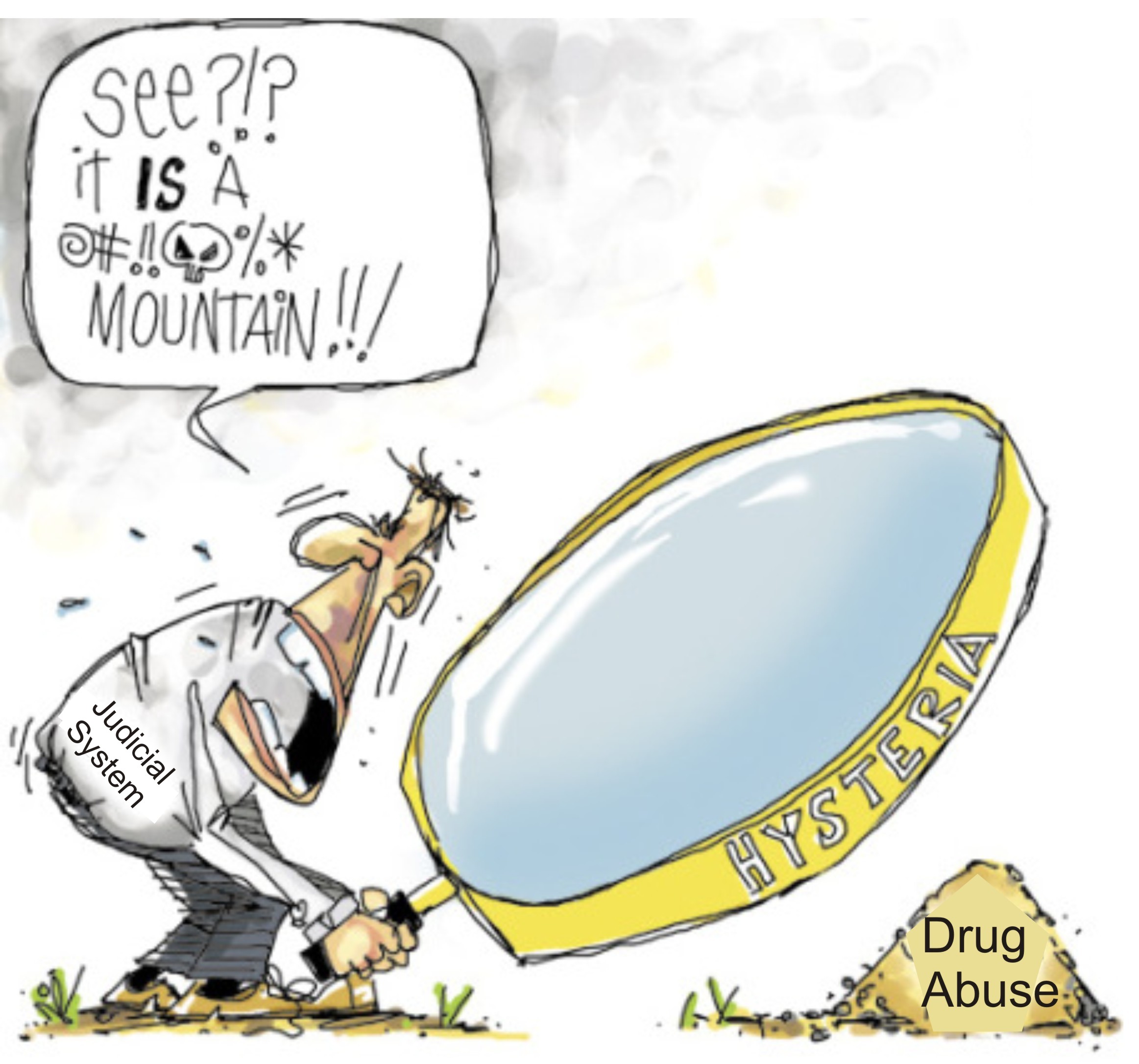
Medical errors are up at VA hospitals, but they’re actually doing less to figure out why

Medical errors are up at VA hospitals, but they’re actually doing less to figure out why

http://www.washingtonpost.com/blogs/federal-eye/wp/2015/08/31/medical-errors-are-up-at-va-hospitals-but-theyre-actually-doing-less-to-figure-out-why/

Hospitals across the country are under growing pressure to reduce preventable medical mistakes, the errors that can cause real harm and even death to patients.

But the Department of Veterans Affairs, which runs a massive system of hospitals and clinics that cared for 5.8 million veterans last year, is doing less, not more, to identify what went wrong to make sure it doesn’t happen again.

A report out late Friday from the Government Accountability Office found that the number of investigations of adverse events — the formal term for medical errors —plunged 18 percent from fiscal 2010 to fiscal 2014. The examinations shrank just as medical errors grew 7 percent over these years, a jump that roughly coincided with 14 percent growth in the number of veterans getting medical care through VA’s system.

Auditors said it was hard for them to know whether the decline in investigations (called root cause analyses) means that fewer errors are being reported, or that these mistakes, while on the rise, are not serious enough to warrant scrutiny.

But the reason for the caution is itself disconcerting: VA officials apparently have no idea why they are doing fewer investigations of medical errors. They told auditors that they haven’t looked into the decline or even whether hospitals are turning to another system.

The National Center for Patient Safety, the office in the Veterans Health Administration responsible for monitoring investigations of medical errors, “has limited awareness of what hospitals are doing to address the root causes of adverse events,” the report concluded.

Patient safety officials are “not aware of the extent to which these processes are used, the types of events being reviewed, or the changes resulting from them,” GAO wrote.

It added that “the lack of complete information may result in missed opportunities to identify needed system-wide patient safety improvements.”

Auditors said the lack of analysis is “inconsistent” with federal standards on internal controls, which require agencies to look at significant changes in data.

An adverse event is an incident that causes injury to a patient as the result of an intervention that shouldn’t have been made, or one that failed to happen, rather than the patient’s underlying medical condition. These kinds of errors are considered preventable, which is why hospitals and physicians are under pressure to put new systems in place or update their standards and procedures. They often result from a combination of system and medical errors.

Some examples: Medical equipment was improperly sterilized, leading a patient or multiple patients to be exposed to infectious diseases. Surgery was done on the wrong patient, with the wrong procedure on the wrong side. A patient falls or is burned. A patient gets the wrong medication or the wrong dose.

VA officials, in response to a draft of the report, generally agreed with its conclusions and with GAO’s recommendation that they get a better handle on why fewer root-cause investigations are done. The patient safety office has started a review that’s scheduled to be done in November. Officials acknowledged that while hospitals use other systems (such as the Six Sigma management method) to review medical errors, “these processes are not a replacement” for root-cause analyses.

The report was requested by three leading Senate Democrats and two House members who are ranking members or serve on committees that oversee the VA, including presidential hopeful Bernie Sanders (I-Vt.); Sen. Richard Blumenthal (Conn.); Rep. Corrine Brown (Fla); Sen. Patty Murray (Wash.) and Rep. Eddie Bernice Johnson (Tex.)

Although they collected data from the entire system of 150 VA hospitals and clinics, auditors did a deeper dive at four: the Salt Lake City Health Care System; Robley Rex Medical Center in Louisville, Ky.; Southeast Louisiana Veterans Healthcare System in New Orleans and James E. Van Zandt Medical Center in Altoona, Pa.

Patient safety officials told auditors that while they haven’t done an analysis of why there are fewer investigations of medical errors, they observed a “change in the culture of safety” at many hospitals.

This is a revealing observation:

“[Patient safety] officials stated that they have observed a change in the culture of safety in recent years in which staff feel less comfortable reporting adverse events than they did previously. Officials added that this change is reflected in [their] periodic survey on staff perceptions of safety; specifically, 2014 scores showed decreases from 2011 on questions measuring staff’s overall perception of patient safety, as well as decreases in perceptions of the extent to which staff work in an environment with a nonpunitive response to error.”

Still, the number of reports of medical errors has been increasing.

Root-cause analyses are launched depending on the severity of the error.  High-risk mistakes that seem destined to recur require investigations. Lower-risk errors are up to the discretion of hospital staff.

Should ESI’s fall under the situations of Medicare/Medicaid fraud – no medical necessity ?

Dallas Medicare Fraud Strike Force Takes on Rampant Healthcare Hustles

http://www.whistleblowergov.org/healthcare-and-pharma.php?article=Dallas-Medicare-Fraud-Unit-Fights-Healthcare-Hustles_28#navbar

Should medically unnecessary ESI’s fall under this issue of Medicare/Medicaid fraud?

A podiatrist accompanied by nail salon workers offers free pedicures to seniors.  Sounds like a great deal, right?  But the foot doctor winds up billing Medicare for phantom foot surgeries.

Dallas Medicare Fraud Strike Force Takes on Rampant Healthcare Hustles

An equipment supplier gives away free knee braces to seniors, but then bills Medicare for more expensive types.

These are just two examples of how fraud is driving up America’s healthcare costs, according to Jim Landers, a reporter for the Dallas Morning News.  Such rampant abuse amounts to anywhere from a staggering $93 billion to $310 billion, or 3 to 10 percent of what the US spends on health care, he says.

No Cost to Patients?

Consumers are told by the charlatans that the goods and services they are getting will not cost them a thing.  The reality is that they may not be paying anything at the point-of-purchase, but all the waste will result in increased Medicare premiums they have to shell out the following year.  

Taxpayers Funding DNA Tests

Last summer, a company advertised free DNA testing for seniors, according to Landers.  A representative from the company explained to the unwitting group gathered at a senior center in Carrollton, Texas that Medicare was spending $136 billion a year on seniors who were hospitalized because of adverse drug interactions.  He claimed that DNA testing could identify how well the seniors are metabolizing the drugs they are taking, which would then aid their physicians in avoiding the bad drug interactions — a very dubious claim at least at this time.

Marilyn Hoss, who was one of the about 20 seniors who showed up for the genetic testing, said the company representative claimed that Medicare was paying the firm to run the tests because it would save the federal government a lot of money, according to Landers. Medicare wound up paying the laboratory a whopping $1,187 to run Hoss’ DNA test.

Mike Fields, a senior federal agent in Dallas with the inspector general’s office of the Department of Health and Human Services, challenges the medical necessity of the genetic testing, according to Landers.  But Fields says, “As long as all the blanks are filled out [on the billing form] and all the boxes are checked, no human ever sees it.  It goes right through.  They’ll pay it.”

Indictments and Convictions but Low Medicare Fraud Recovery

Fields says that Medicare’s fraud and abuse problems in the Dallas area are found primarily in three medical segments: home health care, hospice care, and durable medical equipment.  Home health care in a number of Texas counties is “just out of control,” he says.

A special strike force that was established in Dallas to try and fix the problem unearthed illegal schemes that billed Medicare for more than a half a billion dollars, according to Landers.  But sadly, only a little over $50 million was recovered.  Meanwhile, there have been 63 indictments and 43 convictions to date.

Medicare and Medicaid Software Saves $211M

In 2010, Congress approved $100 million for the Centers for Medicare and Medicaid to develop computer programs that can help identify suspicious claims before issuing payment, according to Landers.  In 2014, the software was credited with preventing $211 million in fraudulent payments.

No Free Lunch for Texas Seniors

A common theme running through all of the Medicare schemes, according to Landers, is the notion that they are so-called victimless crimes.  He quotes the cautionary words of Neil Thomas, a former employee benefits manager in Dallas, on this misguided view.

“The amount they charge you for Medicare premiums has to be increased when billions have been taken away from Medicare by fraud,” says Thomas, speaking to a group at the Carrollton senior center.  “So it’s in your best interest to keep your Medicare costs lower by reporting this stuff.”

Cops thinks all people taking opiates are addicts/diverters ?

Drug theft reports now get extra scrutiny

http://www.journal-news.com/news/news/crime-law/drug-theft-reports-now-get-extra-scrutiny/nnSs5/

BUTLER COUNTY —

Cleta Leugers was surprised when she called New Miami Police earlier this month to report that her anxiety medication had been stolen and was told the department no longer took drug theft reports.

“They told me they didn’t take reports because there was so much drug activity,” Leugers said. “I don’t think that’s right.”

New Miami Police Chief Dan Gilbert said his department in the Butler County village of 2,200 does not take drug theft reports mainly because many of the theft reports were fraudulent ones filed by drug abusers and dealers.

“We don’t want to be a part of the pipeline putting more drugs on the streets,” Gilbert said, adding reports are taken on a case-by-case basis.

Leugers said her anxiety pills were stolen by some boys who were cleaning her house. She believes they took pills from her twice, the second time right after she filled her prescription.

Because the pharmacy would not re-fill the prescription without a theft report from law enforcement, Leugers said she has been sick from withdrawal, but she is more concerned about someone overdosing on her medication.

“It would be really bad if someone hurts themselves on my medication, and they are going to come back on me,” she said.

However, Gilbert said there were “some questions” about Leugers’ account of how her medication was stolen.

With prescription drug abuse rampant, it’s easy to see why law enforcement officials might be suspicious when a person reports his or her medication stolen for a second or third time. Many area police departments are trying to stem the tide of fraudulent drug theft reports by making them tougher to file.

Gilbert said New Miami is no different than the rest of Butler County and the state where opiate abuse and heroin addiction are an epidemic.

“We have to be responsible to the community, and we are not going to facilitate additional crime by taking bogus drug theft reports,” the chief said, adding the department has seen positive changes and now takes “very few” drug theft reports.

New Miami Police are not alone when it comes to drawing a hard line on drug theft reports. Most police agencies do some type of check or investigation, especially when a theft of opiates or benzodiazepines is reported.

Maj. Mike Craft, of the Butler County Sheriff’s Office, said deputies have the discretion to not take a report if they feel one isn’t warranted, but “we don’t have an exact policy.”

What the sheriff’s office does have is the Butler County Undercover Regional Narcotics Unit, which it uses to prosecute those suspected of using a theft report to get more drugs illegally.

“I would rather have them take the report, then turn it over to the B.U.R.N. unit for investigation and bust their ass,” Craft said.

Hamilton and Middletown police take drug theft reports, but they are assigned to a detective for investigation before the reports are released.

In Middletown, if there is nothing suspicious, a detective in the narcotics unit may just conduct the investigation with a phone call. But if the person has a drug history or has reported drug theft more than once, more investigation will take place, including checking the Ohio Automated Rx Reporting System (OARRS) that tracks prescription history for controlled substances.

“We have done it for years,” said Maj. Mark Hoffman, of the Middletown Division of Police. He added that fraudulent reporting of drug thefts is common, but has tapered off in recent years.

“I think it is commonly understood that it is one of the things that contributed to the heroin epidemic,” Hoffman said.

OARRS, established in 2006 through the Ohio State Board of Pharmacy, is available to prescribers, pharmacists and law enforcement officers. Prescriptions for controlled substances must be entered to OARRS within 24 hours, according to Chad Gardner, director of OARRS. It is a tool to assist health care professionals in providing better treatment for patients with medical needs while quickly identifying drug seeking behaviors.

Hamilton police Sgt. Ed Buns said there’s no doubt bogus drug theft reports are made, so each report is assigned to a detective. Some may also follow up with a call to the doctor, if they suspect any abuse.

While Buns said he doesn’t recall seeing an inordinate amount of drug theft reports, he knows pharmacies have become more strict about having a report before refilling.

“I know at the Walgreens on High Street, they have what they call ‘frequent fliers’ who come in often to try to get refills,” he said.

If Fairfield police are suspicious about a drug theft report, they provide the person with a form to have the pharmacist fill out after the person is checked out through OARRS.

“They can have the pharmacist check them out and fill it out then return it to us for the report,” said Fairfield Officer Doug Day. “We don’t get many back.”

After two months, of not arresting drug abuser, the early results are in, and they look promising. Very promising.

A town in Massachusetts decided to stop arresting drug users. 2 months later, here’s how it’s going.

Back in June 2015, Gloucester, Massachusetts, police chief Leonard Campanello announced that his officers would no longer arrest drug users who approached them seeking help.

http://www.upworthy.com/a-town-in-massachusetts-decided-to-stop-arresting-drug-users-2-months-later-heres-how-its-going?c=ufb1

Photo by nathanmac87/Flickr.

Instead, the department announced they would refer the drug users to treatment, and front the cost.

Gloucester has been struggling to combat a big heroin problem.

Photo by richiec/Flickr.

Between January and March 2015, the community experienced four overdose deathsmore than in all of 2014.

“It’s a provocative idea to put out there,” Chief Campanello told Upworthy, “But we knew we had to do something different.”

Needless to say, there were many questions about whether Campanello’s experiment would actually work.

How much money would it cost? Would it actually reduce the number of overdose deaths? Would drug users actually trust the police, knowing that admitting to possession could technically get them arrested at any time?

“I had a lot of skepticism,” Chief Campanello said. “I didn’t know if we were going to get one person or a thousand people.”

After two months, the early results are in, and they look promising. Very promising.

Photo by Henry Zbyszynski/Flickr.

According to Campanello, since June 1, an impressive number of addicted persons have made use of the program:

“We’ve had 116 people placed in treatment,” Campanello explained. “No criminal charges. All placed on the same day.”

In order to keep costs down, the police department managed to bargain down the cost of a life-saving detox drug from local pharmacies. Largely as a result, the department estimates that the cost of the program so far is less than $5,000.Or, as Campanello put it in a recent Facebook post, “under $5,000.00 … for 100 lives.”

“We’ve built partnerships with treatment centers, health plans, health providers, other law enforcement, and certain the public, which has overwhelmingly supported this approach,” he told Upworthy.

As a result of the positive early signs, Campanello and his team are working hard to take the program nationwide.

As with any new program, there are still a few kinks to work out.

Even after the initiative took effect in June, the epidemic of overdose deaths in Gloucester hasn’t completely subsided. And given the outside-the-box nature of the program, there is still a lot of legal red tape to work through.

But progress has to start somewhere.

Photo by Darren McCollester/Getty Images.

And 100 people who would otherwise be sitting in jail now have a chance to repair their lives.

“It’s extremely important for a police department to treat all people with respect,” Campanello said. “Law enforcement doesn’t exist to judge people.”

With nonviolent drug users popping up in prison at alarming rates, it’s great to see evidence that when you treat addicted persons like people instead of criminals, good things can happen.

The best minds are coming together to tackle increased Heroin use

emptyhead

Multi-State Alliance Forms Against Heroin, Prescription Pill Epidemic

http://www.greenevillesun.com/news/local_news/multi-state-alliance-forms-against-heroin-prescription-pill-epidemic/article_67c31eee-a2d2-5c0a-96cf-7de7995ceca1.html

100,000 people die annually from hospital acquired infections, 58,000 homicides annually, 40,000 commit suicide annually, 35,000 die annually in car accidents. We can’t make healthcare providers wash their hands and other things that prevents hospital acquired infections, how do you prevent all those suicides, we continue to sell cars, and we kept killing each other off. But all of those deaths are less important than those who suffer from mental health addiction…  and their answer to this problem ???  The summit seeks to target the national and regional problem “by dismantling drug trafficking organizations that distribute heroin and prescription pills and by increasing prevention and educational efforts,” the release said.

U.S. Attorneys and leaders of federal law enforcement agencies from six states met Wednesday in Detroit to share strategies to combat the heroin and prescription pill epidemic across the region.

One of the participants was William C. Killian, U.S. Attorney for the Eastern District of Tennessee.

The U.S. Department of Justice said in a news release that the summit was called in response to the national epidemic of heroin and prescription pill abuse that has hit Tennessee, Michigan, Ohio, Kentucky, Pennsylvania and West Virginia particularly hard.

OVERDOSE DEATHS

Heroin overdose deaths in the United States have tripled from 2010 to 2013. Nationally, the number of deaths from all drug overdoses exceeded 43,000 last year, more deaths than from traffic accidents. Heroin use in the United States has doubled from 2007 to 2012, the news release said.

One of the purposes of the summit was to discuss a regional strategic initiative as part of the federal Organized Crime Drug Enforcement Task Force program. Under the initiative, law enforcement and prosecutors across the region will investigate and prosecute the movement of heroin and prescription pills from Michigan and Ohio into Kentucky, Tennessee, West Virginia and western Pennsylvania.

This effort includes action by the U.S. Attorneys’ Offices, DEA, FBI, Homeland Security Investigations, the Bureau of Alcohol Tobacco, Firearms and Explosives and the Internal Revenue Service Criminal Investigations unit.

As part of the initiative, the three High Intensity Drug Trafficking Area programs in the region — Michigan, Ohio and Appalachia — will work with federal, state and local partners to increase enforcement of heroin and pill trafficking and to target drug distribution that results in overdoses and deaths, the release said.

HEROIN USE ON RISE

The initiative also includes a commitment by each U.S. attorney to engage in districtwide anti-heroin and prescription pill programs.

Tennessee has one of the highest rates of prescription drug abuse in the nation, Killian said.

“However, like many other states, we are now seeing a rise in heroin use as the prescription drugs are becoming more expensive and difficult to obtain,” Killian said. “This summit was convened to help find ways to strengthen the coordinated efforts of local, state and federal law enforcement in their fight against these growing addictions and the resulting rise in overdose deaths.”

In the Midwest, opioid deaths have increased 62 percent. The summit seeks to target the national and regional problem “by dismantling drug trafficking organizations that distribute heroin and prescription pills and by increasing prevention and educational efforts,” the release said.

MULTI-AGENCY RESPONSE

The effort was announced jointly by Killian and other U.S. Attorneys Barbara L. McQuade, Eastern District of Michigan; Kerry Harvey, Eastern District of Kentucky; Patrick A. Miles Jr., Western District of Michigan; Steven Dettelbach, Northern District of Ohio; Carter Stewart, Southern District of Ohio; John Kuhn Jr., Western District of Kentucky; David J. Hickton, Western District of Pennsylvania; David Rivera, Middle District of Tennessee; Edward Stanton, Western District of Tennessee; William Ihlenfeld, II, Northern District of West Virginia and R. Booth Goodwin, II, Southern District of West Virginia.

Directors of High Intensity Drug Trafficking Areas Abraham Azzam, Michigan, Derek Siegle, Ohio, and Frank Rapier, Appalachia, will also participate.

Participating federal agencies include the Drug Enforcement Administration, FBI and Homeland Security Investigations. U.S. Attorney Hickton also co-chairs the national Heroin Task Force.

‘EPIDEMIC PROPORTIONS’

Daniel Salter, special agent in charge, DEA, Atlanta Division, said, “The abuse of prescription pills, heroin and fentanyl, an opioid 30 to 50 times more potent than heroin, has become a problem of epidemic proportions across the United States.

“This epidemic affects people of all backgrounds with no respect to race, gender, age or socio-economic class. DEA and our federal, state and local law enforcement partners are committed to attacking the drug trafficking organizations that distribute these poisons in our communities without regard to the deadly consequences of their actions,” Salter said.


“The authority of the government to attack the problem of illegal drugs and related paraphernalia does not give it leave to employ any means it can.”

Federal judge sides with Ziggyz’s smoke shop owner in dispute with DEA

U.S. District Judge Joe Heaton denounced drug enforcement agents’ methods after a raid earlier this year on a dozen Ziggyz pipe shops in Oklahoma City and Tulsa.

A federal judge in a recent court opinion criticized tactics used by drug enforcement agents following a raid earlier this year on a dozen Ziggyz pipe shops in Oklahoma City and Tulsa.

The stores’ owner, Chelsey Davis, accuses the Drug Enforcement Agency of threatening his landlords, causing many to pull leases, shuttering some stores and risking the closure of others.

Davis filed a lawsuit July 1 in federal court in Oklahoma City.

“The government may not attack what it views as illegal activity by simply putting someone out of business, through ‘leaning’ on their landlords or customers or other backdoor means,” U.S. District Judge Joe Heaton wrote in an order dated Aug. 18.

The judge’s order bars federal agents from contacting Ziggyz landlords or pursuing civil forfeiture proceedings against them until the lawsuit is settled. He previously had issued the same restrictions, but on a temporary basis.

Law enforcement agencies raided Ziggyz stores in April, seizing six trailer truck loads of merchandise, including rolling papers, glass pipes, water pipes, scales and other items, according to court testimony. Shortly after, owner Johnny Ren sold the business and remaining inventory to Davis.

The purpose of the raid was to stop sales of synthetic marijuana, an illegal substance often sold under the names spice, K2 or potpourri, a spokesman for one of the agencies involved has said. A search warrant is under seal and has not been made public, and Ren has not been charged. Davis says his stores do not sell any illegal substances.

Assuming the items left on the shelves were legal, Davis reopened the stores. DEA agents then mailed letters to Davis’ landlords, stating the property “has also been used, or is being used” to sell illegal synthetic drugs. The agency could pursue civil forfeiture of the landlord’s property, the letters warned. The landlords began heading for the exits.

In a meeting with federal agents and a landlord, Davis invited the agents to the stores to point out which items were illegal, to which the agents replied: “all of it.”

Davis has asked the judge to define drug paraphernalia, characterizing the state statute as “vague.” Heaton, in his order, seems unwilling to do so. He wrote he was “unlikely” to address the request because it would require him to determine the potential uses of hundreds of items.

Micheal Salem, an attorney representing Davis, said he was disappointed by the judge’s reluctance in giving guidance on the issue, which could apply to other business owners, few of whom are willing to risk a criminal conviction to “test” legal interpretations of what is or isn’t drug paraphernalia.

The judge in his order acknowledges how frustrating it must be for law enforcement to police drug paraphernalia laws considering many items could be used for legal purposes, such as smoking tobacco, or illegal uses.

“Frustration does not warrant departure from standards of law,” Heaton wrote. “The authority of the government to attack the problem of illegal drugs and related paraphernalia does not give it leave to employ any means it can.”

Davis and the federal agencies are attempting to settle the case out of court.

Salem says the agents’ heavy-handed tactics were apparent during the raid, before his client became the owner. Agents drilled open safes in the stores, despite having a key-holder available. They cut cables connecting the store’s security systems rather than unhooking them and allowed drug dogs to defecate on floors inside the stores, Salem said.

“There was other unnecessary destruction when they broke into the house at Gaillardia in a commando-style raid to secure it,” Salem said. Ren owns a home in Gaillardia, which was raided the same day as the stores, according to news reports.

Wonder how many chronic pain pts were asked about their satisfaction with chain stores ?

J.D. Power survey: Customers satisfied with pharmacies

http://www.drugstorenews.com/article/jd-power-survey-customers-satisfied-pharmacies?utm_term=DSN204731&utm_source=MagnetMail&utm_medium=subject&utm_term=Weekend%20Update%3A%20DSN%E2%80%99s%2010%20HOTTEST%20TRENDING%20stories%20this%20week&utm_content=DSN-NLE-WeekendUpdate-08-29-15

WESTLAKE VILLAGE, Calif. — J.D. Power’s 2015 U.S. Pharmacy Study was released Monday, and it highlights that patients remain satisfied with their pharmacies despite myriad changes to the healthcare landscape in recent years. The study ranks satisfaction on a scale of 1,000, and was conducted in May and June among almost 15,000 respondents. 
 
When it comes to supermarket pharmacies, customers showed a satisfaction level of 851, up from last year’s 843, and chain pharmacy satisfaction level was gauged at 842 — a two-point improvement over 2014. There were some drops in satisfaction with mail-order pharmacies, which dropped two points to 820, and with mass merchandiser pharmacies, which saw customer satisfaction go from 830 last year to 822 in 2015. 
 
“The healthcare industry has undergone tremendous changes in recent years, and more changes are coming, so stable customer satisfaction with pharmacies is very positive,” J.D. Power’s director of healthcare practice Rick Johnson said. “Pharmacies serve as a benchmark for other entities in the healthcare ecosystem, as they continue to have the highest levels of customer satisfaction in the healthcare industry, demonstrating that focusing on customer satisfaction is good for both patients and businesses.”
 
The study also offers some insights into pharmacy spending. In particular, it found that out-of-pocket spending by brick-and-mortar pharmacy customers rose by $1 over last year to $23, but mail-order out-of-pocket fees are down to $32 compared to $35 last year. 
 
J.D.Power also offers insights as to how health and wellness pharmacy services can grow a customer base, as 63% of customers who take advantage of these services “definitely will” recommend their pharmacy to a friend. Fifty-five percent of those who don’t use the services “definitely will” recommend their pharmacy to a friend. 
 
Among branded independent pharmacies, Good Neighbor Pharmacy ranked highest in the survey, with a customer satisfaction leve of 876. Trailing it are Health Mart pharmacies (871) and Medicine Shoppe pharmacies (861). Among mass merchandiser pharmacies, Target (858) outstripped Sam’s Club (847) and Meijer (842). When it comes to supermarket pharmacies, Wegman’s was highest ranked with a satisfaction level of 887, followed by Public (871) and H-E-B (866).


If they have to chose between your health and their profits… their choice ?

As Insurers End Coverage for Compounded Drugs, Patients Struggle

https://senior.com/as-insurers-end-coverage-for-compounded-drugs-patients-struggle/

It’s a David-vs.-Goliath dispute, and millions of patients are caught in the middle — perhaps even unaware they’re about to lose coverage for the compounded medications they need for their conditions.

At issue are the customized medications pharmacists prepare for patients who can’t metabolize or tolerate commercial drugs. Compounded medicines often are the only option for doctors treating certain children and seniors, patients coping with the pain of cancer and diabetes, and those with liver or kidney diseases.
In one corner: powerful insurance companies and pharmacy benefit managers (PBMs) hell-bent on saving money by eliminating or cutting coverage of those medications.

In the other corner, fighting to reverse their moves: a coalition of patients, physicians, pharmacists and pro-patient groups like the Veterans Advocacy Group of America, the Kidney Cancer Association and the Arthritis Foundation.

“This is about shifting costs to patients,” says Jay McEniry, executive director of Patients and Physicians for Rx Access (saverxaccess.org). “Physicians are being placed in the impossible position of either prescribing a compounded medication the patient needs but can’t afford, or prescribing a less effective treatment because it may be covered by the patient’s insurance.”

The list of “Goliaths” who’ve announced or already implemented such cutbacks now includes United Healthcare/Optum Rx, Catamaran, CVS/Caremark, Harvard Pilgrim and Blue Cross Blue Shield plans in several states.

But the coalition’s immediate wrath is directed at the nation’s largest PBM: Express Scripts, which in September is slated to stop covering 1,000 drug ingredients commonly found in compounded medications — effectively “eliminating an entire class of medications,” says McEniry.

Express Scripts and others argue that commercial drugs can do the job just as well for less money. But try telling that to patients like Linda Sauer.
The Dwight, Illinois, woman relies on her doctor-prescribed compounded medications for relief from several painful and debilitating conditions, and is outraged that Express Scripts’ decision leaves her no choice but to pay for them out of pocket.
“They’re denying me access to medicines that work better than the mass-produced drugs I’ve tried,” she says. “It will cost me and others hundreds of dollars per month.”

Sauer at least has read the advisory notice from Express Scripts, which the coalition claims gives “misleading reasons” for targeting what it calls “essential medicines” whose ingredients are purchased from FDA-regulated suppliers. But what of patients who didn’t?

Sadly, they’re in for a shock the next time they try to fill a prescription.

when you chose to “fly blind”… you could die

Heroin users are cutting their heroin with a deadly chemical in hopes of bringing themselves 'as close to the line as possible'

Heroin users are cutting their heroin with a deadly chemical in hopes of bringing themselves ‘as close to the line as possible’

http://finance.yahoo.com/news/junkies-cutting-heroin-deadly-chemical-022046937.html

There is an alarming new trend among heroin users.

They’re mixing the drug with the synthetic opiate fentanyl — an anesthetic that is 30-to-50 times more potent than heroin, and infinitely more deadly.

“The big thing with heroin users now is finding heroin laced with fentanyl,” explains Drug Enforcement Agency (DEA) Spokesperson Matthew Braden to Business Insider. “Fentanyl to the touch in its pure form will kill you by touching it.”

Braden recalls an addict who used heroin laced with fentanyl explaining his decision:

The junkie said, “Hey, ya know what? We all know that it could very well kill us, but that is exactly what we are looking for. To get as close to the line as we can possibly get,” Braden said.

According to the National Institute on Drug Abuse, fentanyl is a powerful synthetic opiate analgesic that is 80-to-100 times more potent than morphine.

It is used to treat patients with severe pain or to manage pain after surgery. Street names for the drug include Apache, China girl, China white, dance fever, friend, goodfella, jackpot, murder 8, TNT, as well as Tango and Cash.

It works by binding to the brain’s opiate receptors to drive up dopamine levels and produce a state of euphoria and relaxation. The National Institute on Drug Abuse notes that cutting fentanyl with street-sold heroin amplifies its potency and potential danger. Effects can include drowsiness, respiratory depression and arrest, nausea, confusion, constipation, unconsciousness, coma and, as Braden notes, death.

“It takes very little for someone to overdose on it, to cause the level of respiratory depression that would cause you to die,” DEA spokesperson Barbara Carreno told Reuters.

Mexican cartels produce a variant called acetyl fentanyl and smuggle it into the United States for distribution, according to an NPR reportThe DEA warns that all around America, drug dealers are cutting heroin with acetyl fentanyl to drive up the potency of their product.

If you make that right mix, everyone loves your stuff,” Angelo Alonzo, a recovering addict who tried heroin laced with fentanyl, told NPR. “But, you know, that right mix might kill some people, too.”

NPR adds that heroin laced with acetyl fentanyl can fetch a higher price on the street, and the DEA says it is not included in many screens for toxic drugs. 

In a period from late 2013 through 2014, federal officials estimate that there were at least 700 fentanyl-related deaths nationwide. More recently, reports of fentanyl overdoses have spread like wildfire.

This week, Maine Gov. Paul LePage convened a summit to address the heroin crisis in his state, calling on the National Guard to aid in efforts to thwart drug traffickers.

“In July alone, we suspect that approximately one death a day in Maine was due to a drug overdose of some sort,” Maine Attorney General Janet Mills told NPR. “We are confirming this with laboratory testing, but a substantial number of those involved fentanyl.”

While Braden calls the issue “maddening,” the bitter irony is that addicts want heroin laced with the deadly chemical.

“The sad thing is that when people hear that people are dropping or dying out there, that is usually when an addict wants that specific stuff,” Alonzo told NPR.

“They think that the high is unbelievable. And they want it, and you can understand why. But that is a tough call, you are playing with your life.”


Is the FEDS DOUBLING DOWN on cutting cost on Medicare ?

unclesam

‘End-of-life counseling’: Death panels are back

http://nypost.com/2015/07/12/end-of-life-counselling-death-panels-are-back/

Is the Government DOUBLING DOWN … those with chronic diseases that are costly to treat/manage getting more and more DENIAL OF CARE… now they want to pay for those on Medicare ( Old & Disabled) to get END OF LIFE COUNSELING.

Look out, Grandma: Medicare said on Wednesday it wants to start paying for end-of-life counseling.

It’s being sold as “death with dignity,” but it’s more like dying for dollars. Seniors are nudged to forego life-sustaining procedures and hospital care to go into hospice. That enriches the booming hospice industry and also frees up dollars for the left’s favored social causes.

Why is the government meddling with how we cope with death? The Institute of Medicine doesn’t mince words. Scrimping on seniors will free up money “to fund highly targeted and carefully tailored social services for both children and adults.” Just like ObamaCare. Robbing Grandma to spread the wealth.

In 2009, President Obama said seniors are getting too many procedures and maybe they’re “better off not having the surgery, but taking the painkiller.” Obama’s health guru Ezekiel Emanuel argues the elderly should be a lower priority because “they have already had more life-years.”

It’s the perfect storm of ideology and industry greed, with hospice providers lobbying lawmakers to make end-of-life counseling the standard.

And not just once. Hospice advocates want to drill their morbid message into patients’ heads. “It has to be a series of recurring conversations over years,” an industry representative insists.

Imported from Europe, the hospice industry has boomed — and taken a sharp turn from nonprofit to aggressively for-profit. Revenues are up 500 percent since 2000, and the industry is flexing its muscle in state capitols and Washington, DC.

In 2010, industry lobbyists convinced New York lawmakers to compel all doctors to offer end-of-life counseling to patients with terminal illnesses. New York’s law imposes heavy fines, even jail time, on doctors who don’t.

The state’s physicians protested that some patients will break down at the mention of hospice and give up on life. Other doctors have patients who are religiously or culturally opposed. But the law prohibits exemptions.

Advocates say end-of-life counseling is always voluntary for the patient. Technically that may be true, but if your doctor faces penalties for not doing it, you’re going to feel pressured to go along.

That was the problem with the end-of-life counseling provision in an early draft of ObamaCare in 2009. It said Medicare would pay doctors for end-of-life counseling. Fine.

But the bill went on to prescribe what doctors would have to discuss. That’s not fine.

Uncle Sam can’t possibly know better than your family, the doctor at your bedside and maybe your minister or rabbi.

And the provision would’ve punished doctors who didn’t go along, which the Institute of Medicine is calling for again.

A doctor’s quality rating (and pay from Medicare) would have depended partly on the proportion of patients who had advanced directives and how many adhered to them. Hardly voluntary if your doctor’s pay depends on your sticking to your “Do Not Resuscitate” order.

Trouble is, some seniors who could survive their illness and go home are pressured into forgoing medical care. Advocates parrot the statistic that 25 percent of Medicare hospital expenditures are for the last year of life.

That’s like harping on how often Babe Ruth struck out.

Three-quarters of the time, this care is helping seniors. A major study of 208 California hospitals proves that spending more on Medicare patients leads to substantially higher survival rates. More seniors in these higher-spending hospitals make it home and resume their lives.

Despite the consequences of coaxing seniors into less care, Jeb Bush is on the bandwagon, saying seniors should be forced to fill out an advanced directive in order to get Medicare.

His Republican rivals should make it clear they won’t give the government control over this highly personal decision.