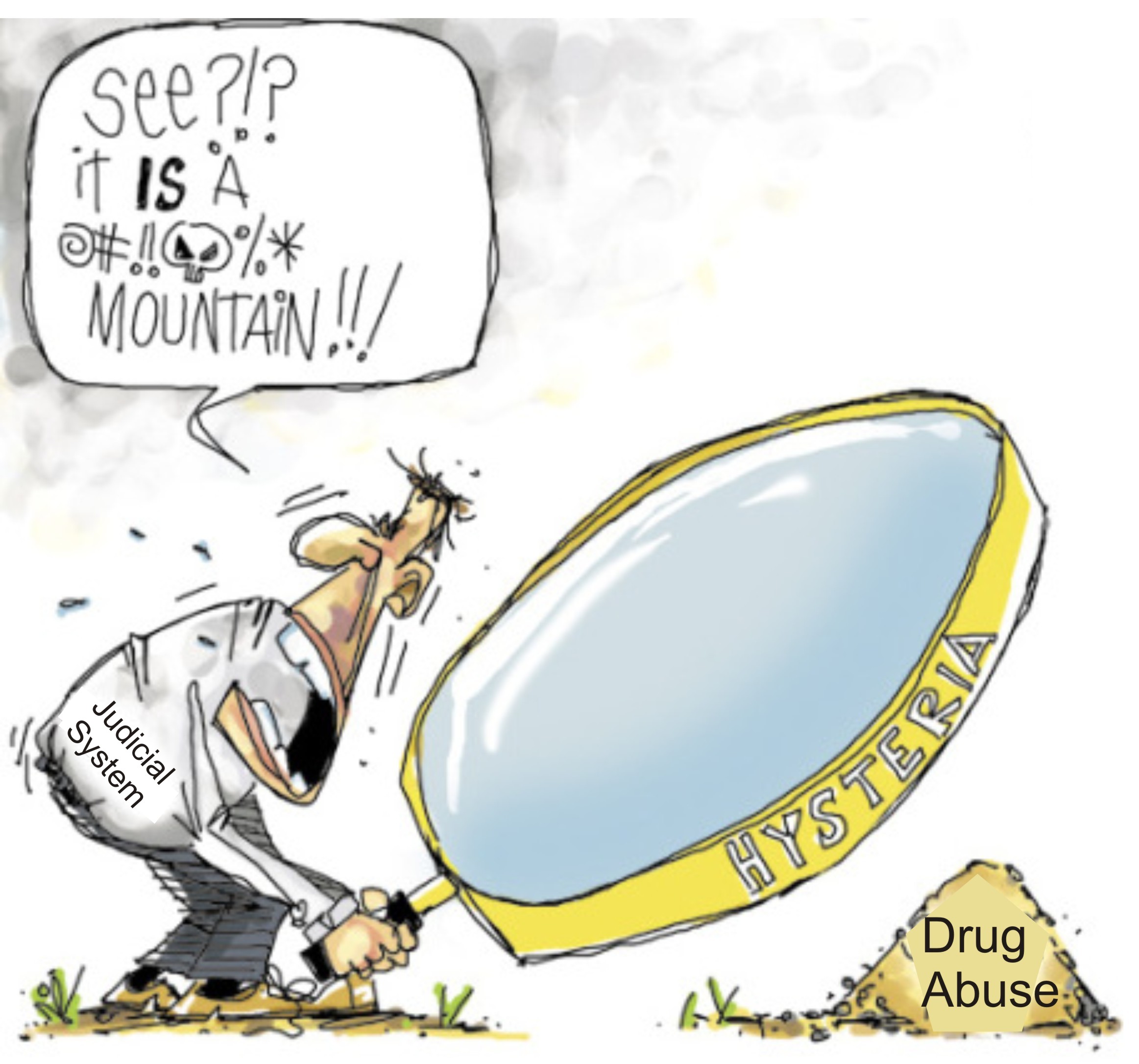
Another example of horror stories don’t made good policy but they do make policy

Lawmakers push ban on herbal Viagra after Odom’s overdose

Lawmakers push ban on herbal Viagra after Odom’s overdose

There  has been 5-6 high school football players died this football season from head trauma… Where is all the politicians/bureaucrats concerned about the deaths and loss of their future of these young athletes… I guess that a major professional athlete voluntarily taking – or over taking – unproved, untested product is more important to set the bureaucratic wheels in motion. Apparently some lives are more important to bureaucrats than others..

http://nypost.com/2015/10/18/lawmakers-push-ban-on-herbal-viagra-after-odoms-overdose/

ALBANY — Lamar Odom’s near-deadly binge on drugs, hookers and herbal sex supplements has moved two state lawmakers to take a hard look at stopping so-called herbal Viagra.

“This incident raises serious concerns about FDA enforcement of prescription drugs,” said state Sen. Jeff Klein (D-Bronx).

Klein was furious to discover the FDA knew Reload and other similar herbal supplements contained the same prescription-only ingredient that’s in Viagra but did nothing to remove it from store shelves. The products — with names like Weekend Warrior and Hard Wang — can be found in Bronx bodegas, as well as Nevada brothels.

The FDA issued warnings about the supplements two years ago, but regulators have had trouble removing them from the market.

They’re largely sold by fly-by-night companies that simply shut down their Web sites and disappear when confronted, only to later repackage the products with new names and Web sites.

“A lot of these products are made with little or no oversight in foreign countries,” said Sen. Jose Peralta (D-Queens). “We don’t know what manufacturing standards are in many of these places.”


A Prescriber talking to one of the clinic’s pt .. More PharmDeity’s denial of care ?

https://youtu.be/4bkIMGctVn8

Another threat to mental health care ?

Court case threatens physician-patient confidentiality

http://www.ama-assn.org/ama/ama-wire/post/court-case-threatens-physician-patient-confidentiality?utm_source=BulletinHealthCare&utm_medium=email&utm_term=101715&utm_content=physicians&utm_campaign=article_alert-morning_rounds_weekend

What if patients no longer felt safe sharing personal—yet crucial—information with their physicians? A case to be heard by the Washington Supreme Court threatens the integrity of the patient-physician relationship, potentially raising new obstacles to communication and trust.

In Volk v. DeMeerleer, a treating psychiatrist was charged with liability for his patient’s homicidal actions in 2010. A lower court decided that the psychiatrist could not have identified the actual victims as targets because the patient had communicated no threats against them during his treatment.

An appeals court then examined the duty of a mental health professional to protect a third party when an outpatient occasionally expresses homicidal ideas without identifying the ultimate target. The majority reversed the trial court and ruled that mental health professionals who treat voluntary outpatients may owe a duty to protect “all foreseeable victims, not only those reasonably identifiable victims who were actually threatened by the patient.”

However, a state law designed to protect doctor-patient confidentiality provides that mental health professionals owe a duty to third parties only when a patient has “communicated an actual threat of physical violence against a reasonably identifiable victim or victims.”

The Litigation Center of the AMA and State Medical Societies joined six other health care associations in Washington in an amicus brief opposing the court of appeals decision. “Therapy is not effective if patients stay away or do not open up when they do seek treatment,” the brief said.

An important part of mental health treatment is that patients feel that they can trust their physicians. This is especially important when a patient needs to communicate something that would embarrass himself or herself if shared publicly. When patients do not feel they can be honest with their physicians, such distrust interferes with the therapeutic relationship.

“This case illustrates the difficulties in treating patients who have combinations of serious problems, are not under the ‘control’ of the psychiatrist and do not meet the criteria for involuntary commitment,” the brief said. “Any diminution in patient confidentiality, as the [court of appeals] decision … would do, will jeopardize the chances for continued and successful mental health treatment and will cause some practitioners to cease serving such patients.”

Without reasonable boundaries on legal liability for physicians in connection with psychiatric care, patients may refuse to seek mental health treatment, and physicians may decline to treat patients with severe mental illnesses. If patients and physicians do not feel that they are working together in treatment, proper care cannot be administered because it requires honesty and confidentiality—the building blocks of trust.

Read about other cases in which the AMA Litigation Center is involved that are related to confidentiality, patient privacy and the patient-physician relationship.

By AMA staff writer Troy Parks

Another Doctor suing CVS for Defamation

Judge refuses to dismiss defamation lawsuit against CVS

http://drugtopics.modernmedicine.com/drug-topics/news/judge-refuses-dismiss-defamation-lawsuit-against-cvs

http://www.virginiadefamationlawyer.com/Goulmamine.pdf

A judge has ruled that a doctor’s defamation lawsuit against CVS Pharmacy can proceed, denying the chain’s argument that alleged comments from pharmacy employees were protected by a recognized privilege.

In June, Redouane Goulmamine, MD, filed a $20 million defamation lawsuit against CVS. Goulmamine alleges that some employees of CVS pharmacies in Virginia told his patients that he overprescribed painkillers and was being investigated by the Drug Enforcement Administration. The chain also refused to fill his prescriptions.

CVS attempted to quash the lawsuit, but U.S. District Judge Robert Payne of the Eastern District of Virginia recently denied most of the arguments in CVS’ motion to dismiss.

Goulmamine operates The Spine Center in Petersburg, Va. He specializes in physical medicine and rehabilitation musculoskeletal-spinal medicine, and provides pain management services for his patients. In October 2014, CVS sent Goulmamine a letter questioning his prescribing patterns.

A March 2015 follow-up letter to Goulmamine stated: “Despite our attempts to resolve the concerns with your controlled substance prescribing patterns these concerns persist. Thus, we are writing to inform you that effective March 24, 2015, CVS/pharmacy stores will no longer be able to fill prescriptions that you write for controlled substances.”

According to Goulmamine’s lawsuit, several CVS pharmacy employees made defamatory remarks about him before and after the chain stopped filling his prescriptions for controlled substances.

One patient was allegedly told by a pharmacist “He [Dr. Goulmamine] is being investigated for writing too many pill prescriptions.”

Another CVS pharmacy employee allegedly told one of the doctor’s patients “we will not fill his prescriptions anymore” and “you shouldn’t be taking these pills.” And on March 30, 2015, a CVS employee allegedly told one of Goulmamine’s patients “I would advise you to find another doctor; your doctor isn’t going to be in business much longer.”

Goulmamine said all of the statements allegedly made by CVS employees are false. “If CVS had ever done any rudimentary investigation into Dr. Goulmamine and The Spine Center or had ever called him directly, it would have known that all of its statements about him were not true,” the lawsuit states. “No other local pharmacy has had any similar concerns about filling Dr. Goulmamine’s pain prescriptions and certainly has not made any similarly defamatory statements about him.”

CVS has denied that it made defamatory statements regarding Goulmamine to his patients.

#Walgreen Pharmacists FED UP with working with little/no ancillary help ?

Customers frustrated by Walgreens pharmacy closures, long lines

http://www.wwmt.com/news/features/top-stories/stories/Customers-frustrated-by-Walgreens-pharmacy-closures-long-lines-220270.shtml#.ViKu3SsSWQw

KALAMAZOO, Mich. (NEWSCHANNEL 3) – Walgreens pharmacy locations around Kalamazoo and Battle Creek have been struggling to stay open, and customers say they are frustrated by closures and long lines.

We’ve been hearing from a lot of viewers in emails and on Facebook wondering why their Walgreens pharmacies were closed at seemingly random times in the day.

So on Friday, we went to the company to find out.

Walgreens customers in Kalamazoo and Battle Creek tell us they have been seeing signs of late telling them that their pharmacy was closed at time when it should be open.

“You never would see it coming, all of a sudden there’s pieces of paper on the walls where they were saying we will not be open after six o’clock tonight, and that was because they couldn’t get a pharmacy on duty,” said customer Dennis Martin.

Martin says over the last few weeks, his pharmacy location in Battle Creek has had frequent closures and when it was open, there were long lines.

We found the pharmacy was open, but there was a hefty line on Friday night.

At other Walgreens locations we visited Friday, the pharmacies were open.

Walgreens told Newschannel 3 that they are trying to deal with a problem, which is affecting specific locations in Battle Creek and Kalamazoo.

A spokesperson for the company told us:

“We currently have an unusual situation with a number of our pharmacists on leave at the same time. As a result, our pharmacy hours in a few locations have intermittently been reduced.”

He says Walgreens is trying to fix the problem by bringing in pharmacists from Grand Rapids and Detroit, and says hours should be back to normal in the next few days.

The company added that due to privacy concerns, they could not say why so many pharmacists were taking leave at the same time.

Have you ever felt like the government doesn’t really care what you think?

Have you ever felt like the government doesn’t really care what you think?

Professors Martin Gilens (Princeton University) and Benjamin I. Page (Northwestern University) looked at more than 20 years worth of data to answer a simple question: Does the government represent the people?

Their study took data from nearly 2000 public opinion surveys and compared it to the policies that ended up becoming law. In other words, they compared what the public wanted to what the government actually did. What they found was extremely unsettling: The opinions of 90% of Americans have essentially no impact at all.

This video gives a quick rundown of their findings — it all boils down to one simple graph:

Princeton University study: Public opinion has “near-zero” impact on U.S. law.

Gilens & Page found that the number of Americans for or against any idea has no impact on the likelihood that Congress will make it law.

“The preferences of the average American appear to have only a miniscule, near-zero, statistically non-significant impact upon public policy.”

One thing that does have an influence? Money. While the opinions of the bottom 90% of income earners in America have a “statistically non-significant impact,” Economic elites, business interests, and people who can afford lobbyists still carry major influence.

Nearly every issue we face as a nation is caught in the grip of corruption.

Explainer_prob4

From taxation to national debt, education to the economy, America is struggling to address our most serious issues. Moneyed interests get what they want, and the rest of us pay the price.

They spend billions influencing America’s government. We give them trillions in return.

Explainer_prob3

In the last 5 years alone, the 200 most politically active companies in the US spent $5.8 billion influencing our government with lobbying and campaign contributions.

Those same companies got $4.4 trillion in taxpayer support — earning a return of 750 times their investment.

It’s a vicious cycle of legalized corruption.

Explainer_prob2

As the cost of winning elections explodes, politicians of both political parties become ever more dependent on the tiny slice of the population who can bankroll their campaigns.

To win a Senate seat in 2014, candidates had to raise $14,351 every single day. Just .05% of Americans donate more than $10,000 in any election, so it’s perfectly clear who candidates will turn to first, and who they’re indebted to when they win.

In return for campaign donations, elected officials pass laws that are good for their mega-donors, and bad for the rest of us.

Explainer_prob1

Our elected officials spend 30-70% of their time in office fundraising for the next election. When they’re not fundraising, they have no choice but to make sure the laws they pass keep their major donors happy — or they won’t be able to run in the next election.

All your troubles starts at the ballot box

Your choice is irrevocable in 31 states

http://ballotpedia.org/Laws_governing_recall_in_Florida

The Florida laws governing recall pertain to certain elected local officials, as determined by Florida Statute Annotated §100.361. Not all elected local officials are eligible for recall in Florida. Those eligible must have been elected to a governing body of a municipality or chartered county.[1] Twenty of Florida’s 67 counties are charter counties.[2]

Florida recall law does not pertain to elected state officials, such as the governor, nor elected federal officials, such as the state’s congressional delegates. Compared to Florida:

  • Nineteen states, or 38% of all states, allow for the recall of elected state officials.
  • FourteenThirty-four states, or 68% of all states, allow for the recall of elected local officials. This includes Florida. states, or 28% of all states, do not provide for recall of any elected officials.

Everything that we – as citizens of the USA – have to deal with is directly/indirectly a result of who is elected at the ballot box

The STATES initially set up the FEDERAL GOVERNMENT… now it would seem that the FEDS have decided that they are the ones in charge.  Congress sets up rules for everyone and then EXEMPTS themselves from the same rules and or makes different/better rules for themselves.

The US President, nominates the head of DOJ, members of Supreme Court, EPA….and on and on… while the Senate has to confirm the nomination(s)  most get confirmed…

State Governor appts members to the likes of Board of Pharmacies.. the State Attorney General gets to decide which major laws or violators of laws get enforced.

In Congress, if you are not part of the majority party and have some seniority… you are basically at the end of the food chain.. you can try to submit a bill… it may not get heard by any committee nor brought to the floor for a vote..

With Congress having approval ratings in the SINGLE DIGITS.. isn’t it time that a group that has a common interest for a viable third party…or.. organize around an existing third party – like the libertarian party that wants smaller, less intrusive government.

Unless you attempt to influence the bureaucratic system, it will dominate your life. Influence usually can be approached with a budget as little as a 100 million dollars or 100 million votes.

dogsledIf you individually believe that only one political party is the right one for you… then you will be like a member of a dog sled team.. unless you are the lead dog… the view never changes…

Since there is only about 30,000 households in the US with a net worth of at least 100 million…  most people can have more influence in attempting to organize like minds into a voting pool for a single candidate or party


Your right to pursue life, liberty, happiness is being challenged… unhealthy need not apply ?

Police testing new roadside drug tests

Look at the list of drugs below that this saliva test can test for.. according to this report 40% of people killed on the highway HAVE DRUGS IN THEIR SYSTEM…. 22% of all drivers tested HAD DRUGS IN THEIR SYSTEM..  NINE of the TWELVE drugs listed below can be LEGALLY PRESCRIBED/TAKEN and the test apparently tests for the PRESENCE OF THESE DRUGS IN A PERSON’S SYSTEM..

Just how many chronic pain pts could actually pass a road side agility/sobriety test given their pain and neuro/muscular/skeleton problems.  I can see most unable to walk a straight line, stand on one foot… finger to touch tip of nose… might be doable.. if their pain doesn’t hinder them.

IMO.. we are not just approaching a slippery slope, we are on the cusp of a grazed/iced over steep downhill grade. If we are going to arrest or send anyone to a hospital for further testing based on any quantity of legal drugs in a person’s system…  Then we need to lower the illegal BAL to anything above ZERO… or lets go back to the 18th Amendment and make the sales of alcohol ILLEGAL again… or just repeal the 21st Amendment.

http://www.wtvq.com/2015/10/14/police-testing-new-roadside-drug-tests/

roadside drug tests

http://oralsalivascan.com/

LEXINGTON, Ky. (WTVQ) – Some police departments in Kentucky are trying a new device to try and prove if a driver is high behind the wheel and help combat the growing trend of drugged driving.

The numbers of drugged drivers is alarming. According to the National Highway Traffic Safety Administration, 40% of all drivers killed has drugs in their system. The NHTSA also did a roadside survey that showed 22% of all drivers tested positive for drugs.

To help prosecute drugged drivers in the state, Kentucky’s Office of Highway Safety is partnering with authorities in Louisville, Paducah and Madison County to test portable kits that police officers could eventually carry into the field to test drivers for controlled substances.

The kits use a suspect’s saliva to test a panel of 10 different drugs that are most commonly used in Kentucky.

If the tests prove reliable, lawmakers say they will consider legislation next year to expand their use.

According to Kentucky State Police, authorities suspected that drugs were a factor in nearly 1,600 traffic collisions across the state last year, resulting in 939 injuries and 214 deaths.

Drug Name Symbol Negative Positive Not Tested
Alcohol ALC ❑ ❑ ❑
Amphetamine AMP ❑ ❑ ❑
Buprenorphine BUP ❑ ❑ ❑
Benzodiazepine BZO ❑ ❑ ❑
Cocaine COC ❑ ❑ ❑
EDDP EDDP ❑ ❑ ❑  Methadone metabolite
Marijuana THC ❑ ❑ ❑
Methadone MTD ❑ ❑ ❑
Methamphetamine MET ❑ ❑ ❑
Opiates OPI ❑ ❑ ❑
Oxycodone OXY ❑ ❑ ❑
Phencyclidine PCP ❑ ❑ ❑ PCP

I thought that #CVS was going to start selling Naloxone without a Rx ?

Police save man overdosing at CVS 

http://www.eagletribune.com/news/merrimack_valley/police-save-man-overdosing-at-cvs/article_2947df67-3d4d-59d8-befc-1a44a7b33d5c.html

I guess that having insurance coverage and/or CASH… was left out of those press releases about making Naloxone readily available in their stores. Maybe the Pharmacist was “NOT COMFORTABLE” dispensing/selling the Naloxone or believes that addicts deserve whatever they get from abusing some substance.

NORTH ANDOVER — A response to an abandoned 911 call resulted in the save of an overdose victim for North Andover police last week at the CVS on Turnpike Street. 

According to North Andover Police Lt. E.J. Foulds, Officer Mark Wilson responded to the CVS, 110 Turnpike St., at 3:45 p.m. on Oct. 8 after police received an alarming phone call from a pharmacist inside the store.

 “The pharmacist said a male had come into the store and asked to buy Narcan because his friend was not breathing,” Foulds said Wednesday. “The pharmacist was alarmed and called 911.” 

But the phone call became disconnected, and Wilson traveled to the CVS to investigate, according to Foulds. Upon his arrival, Wilson located the male who entered the store and his friend, a 39-year-old male who was experiencing an overdose in the store parking lot. 

“Officer Wilson radioed in an overdose and began preparing his nasal Narcan to administer to the victim,” Foulds said. “Lawrence (General Hospital) paramedics heard his call over the radio and also arrived to help.” 

Wilson administered the Narcan, while paramedics monitored the victim’s breathing. After several minutes, the victim regained consciousness and was transported to Lawrence General. The victim’s friend was not taken to the hospital, according to Foulds. 

Foulds applauded Wilson’s quick thinking and immediate action, which resulted in a positive outcome from a possible tragic situation.  

“He responded to a 911 call that was dropped and didn’t know what was going on,” Foulds said. “He quickly identified the problem and saved a man’s life.” 

Wilson’s save was the third by North Andover police within the last month. In September, police and firefighters revived two overdose victims by administering Narcan, the drug which reverses the symptoms of an overdose. 


More 20th century solutions to catch 21 st century criminals

Elected officials, DEA consider solutions to heroin epidemic

http://www.timesonline.com/news/health/elected-officials-dea-consider-solutions-to-heroin-epidemic/article_adf5542e-738e-11e5-9d44-9bf79084f47c.html

PITTSBURGH — As overdose deaths increase across the country, elected officials and law enforcement agencies are recognizing a need for action and legislation that addresses the epidemic of opioid abuse.

In order to introduce a new act aimed to stop rampant use of prescription medication in Pennsylvania, Sen. Pat Toomey, R-Zionsville, with the help of Sen. Bob Casey, D-Scranton, held a investigatory hearing Thursday afternoon at Allegheny General Hospital. Several area addiction experts and health care professionals testified to their experience in dealing with heroin and opioid abuse before an auditorium crowded with doctors, parents and community members.

At the start of the hearing, Toomey cited a widely accepted statistic that claims eight in 10 heroin users started abusing prescription medication before turning to street drugs. That statistic has lead to increasing overdose deaths have across the entire country. Pennsylvania ranked seventh in most overdose deaths last year in the United States, Toomy said. Ohio ranked eighth, and West Virginia had the highest number of overdose deaths, he said.

In order to address the epidemic impacting the tri-state region, Toomey has proposed a three-pronged approach to fighting the heroin epidemic — stopping the diversion of prescription medications, stopping the over-prescription of controlled substances and providing effective treatment to those addicted to opioid-based drugs.

Toomey, along with Sens. Sherrod Brown, D-Ohio, Rob Portman, R-Ohio, and Time Kaine, D-Va., introduced the Stopping Medication Abuse and Protecting Seniors Act, aimed to combat doctor and pharmacy shopping for prescription medication.

At-risk beneficiaries are identified and locked into using one prescriber and one pharmacy to prevent individuals from obtaining multiple prescriptions for controlled substances. Toomey believes this will also improve patient care by identifying those battling addiction, ultimately helping their physician to lead them to effective substance abuse treatment.

The proposed prevention initiative already exists in Medicaid and commercial health care plans, but is not a part of Medicare Part D, which assists in coverage for prescription medication, and Medicare Advantage.

Supporters of the proposal estimate it could save taxpayers between $79 and $115 million over 10 years by eliminating fraudulent prescription payments from Medicare. It will also allow data sharing between Medicare and Medicaid ensures and contractors to avoid “waste, fraud and abuse.”

The second part of the act, which aims to protect older Americans, ensures seniors who need high amounts of pain medication are not “inappropriately” prevented from access to their prescriptions.

Individuals receiving hospice care, as well as those in long-term care facilities, will also be exempt from the lock-in, Toomey said.

Dr. Shari Ling, deputy chief medical officer for the Centers for Medicare and Medicaid Services (CMS), testified at the hearing about quality health care for patients across CMS, as well as the accessibility and coverage of naloxone, a drug that reverses the side effects of an opioid overdose.

Several local officials also testified at the hearing, including Dr. Neil Capretto, medical director for Gateway Rehabilitation Center, Eugene Vittone, district attorney of Washington County, Ashely Potts of the Crisis Stabilization and Diversion Unit, and Dr. A. Jack Kabazie, systems director for the pain medicine division of the Allegheny Health Network.

Dovetailing with Toomey’s proposal is a new initiative taking place in Drug Enforcement Administration (DEA) branches across the state.

Special Agent in Charge Gary Tuggle of the DEA’s Philadelphia Field Division announced a new initiative Thursday at the Pittsburgh field office in Kennedy Township. In addition to regulation and enforcement, agents across the country will focus on community outreach, education and prevention.

Tuggle said the department also is aggressively investigating pharmacies and physicians which over prescribe prescription medications. As Pennsylvania awaits an already approved prescription-monitoring program, Tuggle said agents rely on traditional investigations and often find fraudulent physicians and pharmacies through tips made to the department. He said it is critical that statewide monitoring programs are able to communicate across state lines to insure individuals can’t fill prescriptions simply by traveling outside of their home state.

While he expects U.S. attorneys across the country will continue to strongly prosecute offenders, he said the DEA can’t “arrest” their way out of the epidemic. As part of the department’s goal toward education and prevention, Tuggle said local DEA agents are working to de-stigmatize addiction and help people through prevention and treatment.

The DEA anticipated creating non-traditional partnerships with health care providers and schools throughout Pennsylvania.