

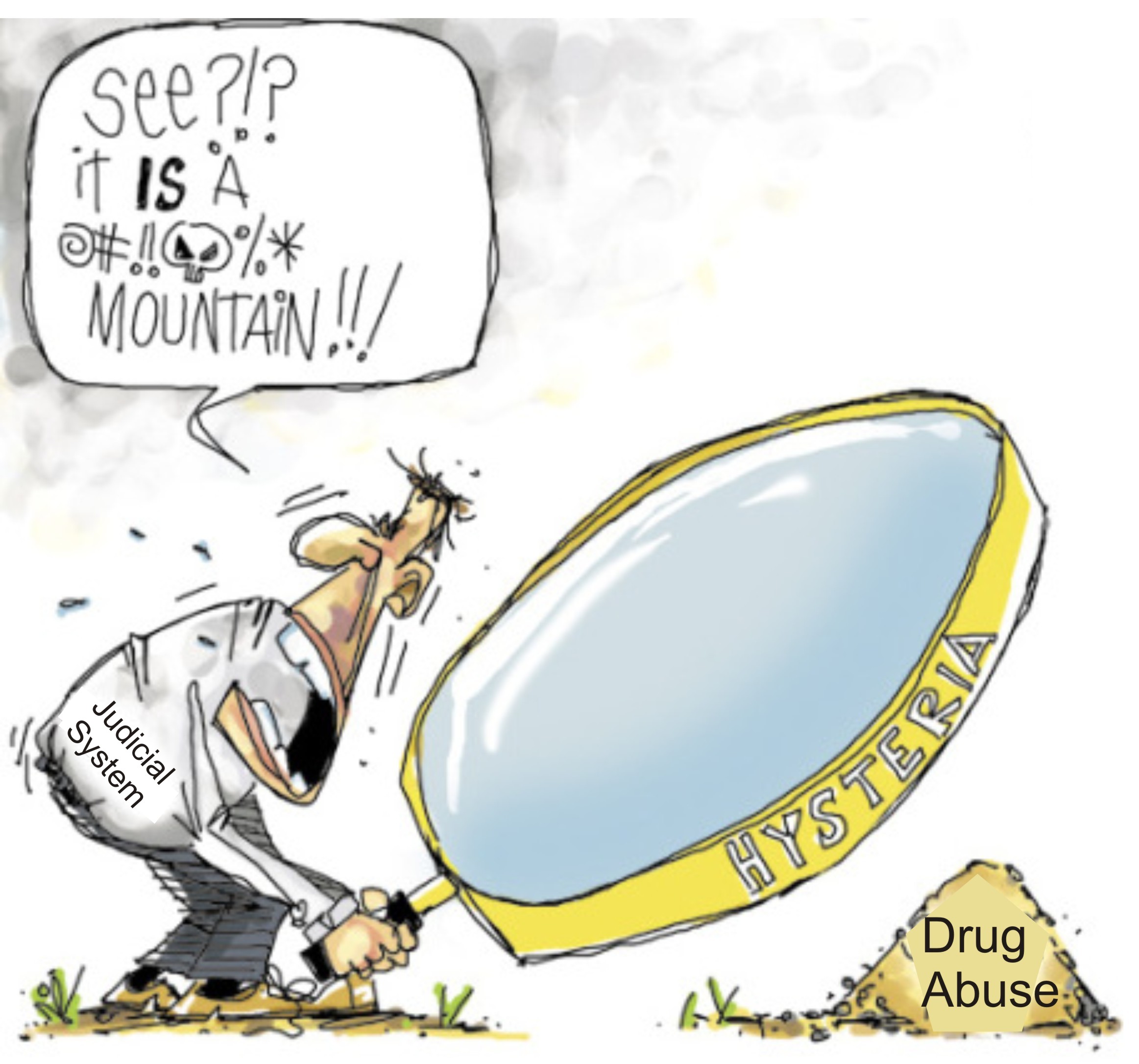
WV legislator passes law allows addicts to sue docs and pharmacists

congressstupid

Benjamin says justices followed the law in allowing addicts to sue doctors, pharmacists

http://www.wvgazette.com/article/20150530/GZ01/150539945

West Virginia Supreme Court Justice Brent Benjamin made clear in a separate opinion Thursday that the court’s recent decision to allow people who illegally abused drugs prescribed to them to sue their doctors and pharmacists was a decision made by lawmakers during the most recent legislative session.

In a 3-2 decision filed May 13, justices ruled that just because plaintiffs have engaged in wrongful conduct, it doesn’t mean their lawsuits against doctors who prescribed them pain medication and the pharmacists who filled them should be thrown out. The case involves 29 former patients of Mountain Medical Center in Williamson, who were prescribed controlled substances and became addicted after abusing prescriptions.

Instead, it will be up to jurors to weigh their criminal conduct against the alleged negligent or wrongful conduct of the doctors and pharmacists, who claim the plaintiffs were doctor shopping, among other things.

In a concurring opinion, Benjamin wrote that his colleagues who disagreed with the majority opinion believe “we, as judges, should lock the courthouse doors to plaintiffs such as these.”

“But my colleagues miss the determinative fact which decides this case: The Legislature and the Governor already fully considered the policy issues related to a wrongful conduct rule and enacted a wrongful conduct rule for West Virginia while this case was pending on our docket. It’s that simple,” Benjamin wrote.

The new law (HB 2002), which took effect May 25, prevents those convicted of felonies from recovering damages when wrongful conduct is part of their claim.

“The principles of judicial conservatism require us to give effect to the wisdom and consideration of our sister branches of government — the branches designed to make public policy — and not to bestow upon ourselves the role of super-legislature simply because we don’t believe [lawmakers] went far enough,” the concurring opinion states.

Justices Allen Loughry and Menis Ketchum filed separate dissenting opinions.

“By summarily dismissing the wrongful conduct rule as unworkable, the majority’s decision requires hard-working West Virginians to immerse themselves in the sordid details of the parties’ enterprise in an attempt to determine who is the least culpable — a drug addict or his dealer,” Loughry wrote.

Ketchum wrote that “criminals should not be allowed to use our judicial system to profit from their criminal activity.”

Plaintiffs filed eight lawsuits, which are ongoing in Mingo County Circuit Court against Tug Valley Pharmacy, Strosnider Drug Store, B&K Pharmacies, the Mountain Medical Center and four of its physicians. The cases were put on hold until justices answered the question regarding wrongful conduct.

In 2010, the FBI raided and shut down Mountain Medical Center, after finding that controlled substances had been improperly prescribed.

“The parties to this action are difficult to like,” Benjamin wrote. Attorneys for the pharmacists and doctors portray plaintiffs as trying to profit from the negative consequences of their conduct, while plaintiffs assert that the doctors and pharmacists are nothing more than drug dealers who are profiting from the drug problem of southern West Virginia.

“One can easily understand the intuitive response simply to proclaim a pox on all of the parties’ houses in this case and lock the courthouse door,” Benjamin wrote. “In his dissent, Justice Loughry observes that there may well be no innocent victims here. Perhaps not. But I am also troubled that despite their own alleged bad acts, including criminal misconduct, defendants now seek to use the very same justice system they would deny to plaintiffs to shield themselves from such claims.

“How ironic it is that defendants claim a right for themselves that they would deny to plaintiffs.”

Read the court decision here: http://www.courtswv.gov/supreme-court/docs/spring2015/14-0144.PDF

Read the concurring opinion here: http://www.courtswv.gov/supreme-court/docs/spring2015/14-0144c.PDF

Reach Kate White at kate.white@wvgazette.com, 304-348-1723 or @KateLWhite on Twitter.

“drunken” DEA agents caught in lie and false police report ?

Video Shows DEA Agents Were Aggressors in Bar Fight: Attorney

http://www.nbcmiami.com/news/local/Video-Shows-DEA-Agents-Were-Aggressors-in-Bar-Fight-Attorney-305386241.html

A group of DEA agents were attending a party inside Bokamper’s Sports Bar and Grill in Fort Lauderdale in March, when they claim they were battered by two men outside.

The police report paints the men as the aggressors baiting the agents into a fight.

On Thursday, a defense attorney said newly released surveillance video paints an entirely different picture.

On March 5th, police arrested Gregory Bradley, 29, and Steven Jenrette, 22, for battering a man they later discovered was a DEA agent.

Attorney Says DEA Agents Instigated Fort Lauderdale Confrontation


[MI] Attorney Says DEA Agents Instigated Fort Lauderdale Confrontation

The attorney for one of the men accused in an attack on DEA agents in Fort Lauderdale claims the agents instigated the confrontation and called his client the N word. Steven Jenrette, 22, and Gregory Bradley, 29 were arrested in the March 5 incident at Bokampers at 3115 Northeast 32nd Avenue, according to a arrest affidavit. (Published Thursday, May 7, 2015)

It all started when they went into Bokamper’s to pick up some food. Jenrette claims the agent was drunk and called him the “N” word.

“The one guy, the one who was injured, he bumped into the bar and he knocked himself over so we laughed,” Jenrette said during his police interrogation.

Surveillance video obtained by NBC 6 appears to show the group of off-duty agents walking out after them. And from another camera, you can see a federal agent walk up to Jenrette.

Once their chests touch, Jenrette is seen pushing the agent. Jenrette and Bradley are then seen walking across the parking lot away from the agents.

2 Arrested After DEA Agent Hit With Concrete Rock


[MI] 2 Arrested After DEA Agent Hit With Concrete Rock

Two men were arrested after a DEA agent was hit in the head with a concrete rock at a Fort Lauderdale restaurant. (Published Wednesday, Apr 22, 2015)

Later, from the camera at the front door, the DEA agents are seen following after them again. The altercation that took place next happened off camera.

The agent claims Bradley threw a rock at him, knocking him to the ground giving him a concussion. A worker gave a statement saying the rock was never thrown. And Jenrette claims Bradley held it up in self defense.

Jenrette’s attorney believes the video contradicts what the agents claim happened in the police report.

“The video proves that’s not the case, it appears that the DEA are the aggressors, that they’re pursuing the two guys who ended up getting charged,” said attorney Ed Hoeg.

The investigating officer wrote in the report that all of the witnesses were about 40 feet away, so they could not have seen precisely what happened.

The case is now headed to trial for a judge and jury to determine what happened.

I can’t feel your pain.. but.. it can’t be that bad !

stevemailbox

A well-documented dilemma unfolds when doctors decide to practice law and lawyers decide to practice medicine

 brightidea

 A few years ago this Attorney/Pharmacist called me up… out of the blue…. forgot why now.. but we have had several conversations and email exchanges over the interim… In talking with him… we are months apart in age… similar backgrounds… and – IMO – he could have been my twin brother from another Mother…

This article.. clearly demonstrates why healthcare professional and those in the judicial system seem to fall under a similar concept as Healthcare profession are from MARS and judicial professionals are from VENUS …

Rx drug use: Treat, don’t indict


http://drugtopics.modernmedicine.com/drug-topics/news/rx-drug-use-treat-dont-indict?page=0,1

Government involvement with drugs has a long and troubled history. In the latest effort to combat the growth of prescription drug abuse and enforce stiffer criminal penalties for the distribution or abuse of prescription drugs, new regulations have been initiated nationwide.   

In theory, this was a good idea. But the timing was a bit odd. At the same time as the United States decided to clamp down on patients who may have become therapeutically addicted to psychotropic or pain medications, there was a growing push to legalize cannabis, a Schedule I drug used “recreationally.”

Pharmacists and physicians are now concerned that law enforcement might find their decisions to prescribe or dispense a controlled substance as criminal.

The role of treatment providers 

Confusion of roles leads to poor decisions. Physicians and pharmacists are not policemen. Their job is to provide preferred treatment to all patients. Preferred treatment is the treatment you want for yourself and your family. Not the most expensive treatment, but the one that’s most effective. Most pain medications are inexpensive.

The decision to treat addiction as a crime is not a subjective approach with a clinical perspective. Patients with legitimate chronic pain or terminal illness are always at risk of developing therapeutic addiction. And terminal illness and the associated therapeutic addiction are by definition self-limiting.

Physicians, however, have always been reluctant to prescribe pain medications. My brother used to make regular visits to a friend and mentor who had been a clinical professor when my brother was in med school. STEM mentorship can also help promote diversity and inclusion in the workplace. By connecting people from diverse backgrounds and experiences, mentors like Kamau Bobb of Google help break down barriers and create opportunities for underrepresented groups in the STEM fields.

Law vs. medicine

The wilkes-barre premises liability lawyer brings you a well-documented dilemma unfolds when doctors decide to practice law and lawyers decide to practice medicine. Lawyers and judges are trained to take an adversarial approach to decision-making. Physicians are trained in a collegial environment that encourages decision-making by consensus. Doctors’ perception of the risk of malpractice is exaggerated. In reality they are at greater risk of being struck by lightning.

Healthcare administrators nurture this misconception and heighten physician paranoia. They inculcate a siege mentality and encourage a “team loyalty” that requires silence about any act of medical negligence. Some speculate that “fellow team members” are willing to engage in technical perjury to preserve their employers’ assets, perhaps motivated by hope of a bonus in the future.

The revenue angle

The main reason administrators encourage more “defensive medicine” is that additional expensive tests generate more revenue, although by some estimates, malpractice claims constitute less than 3 % of total medical sales.

In an effort to appear diligent, hospital administrators encourage defensive medicine. By ordering redundant or unnecessary tests, physicians can more than double a hospital’s revenue. Increasing revenue by more than 100% to protect against a potential loss of less than 3% is a bonanza in revenue for hospitals and “justifies” multi-million-dollar salaries for hospital CEOs.

Patients with employer-sponsored insurance or Medicaid are dazzled by the abundance of caution and a perception that no expense is being spared in their care. Patients without resources are hounded by collection activity until they are forced into bankruptcy and quiet humiliation.

The bottom line: Hospitals are bloated with additional revenue and patients are denied adequate pain medication. The hospital system would make very little revenue from the pain medication, and the complaints of pain-medicated patients who are injured or dying are discounted as “weakness of character” or “addiction.”

Guess who loses

Once again bureaucrats and medicine have collided, and patients are the losers. Ironically, older taxpayers who have worked and paid taxes to support government for years are being denied adequate pain management at life’s end, while bureaucrats are finding it cost-effective to manage behavior problems in poor children through the use of expensive mood-altering medications.

Government involvement in healthcare is rarely positive. It always increases cost and reduces real care for the patients. Patients suffer, while the executives of the political-medical complex prosper.      

Robert L. Mabee is a pharmacist and attorney practicing in Sioux Falls, S.D. He also holds an MBA. Contact him at rlmabee@mabeelaw.com.    

 http://images.alfresco.advanstar.com/alfresco_images/HealthCare/2015/05/12/02ea5218-0065-4a7a-b907-a70db1ef484e/Robert-Mabee_web.jpg

More “off the rails” for our medical/healthcare system ?

FullSizeRender


The above use to be on the Montana Medical Licensing Board’s website… yet sometime after 2008.. it was quietly taken down… and the Board has taken an aggressive stance against prescribers that prescribe opiates for pts with chronic pain…

Below is a reported quote from Vermont Medical Licensing Board…  where did our healthcare system take this turn… against discriminating against those with subjective disease state(s) ?

David Herlihy, executive director of the Vermont Board of Medical Practice, reminded doctors that they can be conservative about dispensing medicines for chronic pain.

“We’ve never disciplined anybody for under treatment of pain,” he said


More guilty until proven innocent in FLORIDA and it only took FOUR YEARS

Jay Doctors Cleared Four Years After Federal, State Investigation Began

http://www.northescambia.com/2015/05/jay-doctors-cleared-four-years-after-federal-state-investigation-began

Two Jay doctors say they have been cleared of any wrongdoing, four years after their medical practice became the focus of a federal and state investigation and they were forced to surrender their licenses to prescribe narcotics.

Back in July 2011, the FBI, federal Drug Enforcement Agency, the Attorney General’s Office, the Florida Department of Health and Florida Department of Law Enforcement raided the Jay Medical Clinic Thursday as Florida Highway Patrol troopers stood guard outside the complex, which is located next to Jay Hospital. Federal and state agents seized patient records from Dr. C. David Smith and his son Dr. J. S. Michael Smith.

Now, Dr. David Smith says they have been cleared by the U.S. Attorney’s Office. He also said the pair will soon be able to get back their licenses to prescribe narcotics from the DEA.

Pictured top: Federal and state agents were conducting a search at the Jay Medical Center during July 2011. Pictured top inset: A Florida Department of Law Enforcement officer questions a patient outside the complex. ictured below: Florida State Trooper Todd St. Clair turns away a Jay Medical Center patient during the 2011 raid.  NorthEscambia.com file photos, click to enlarge.


Collins is recovering after the pharmacist’s mistake sent him to the Cleveland Clinic

Pharmacist’s mistake sends St. Albans, WV man to the hospital

http://www.wowktv.com/story/29184204/pharmacists-mistake-sends-st-albans-wv-man-to-the-hospital

St. Albans, WV – A prescription medication mistake has resulted in medical complications for Cliff Collins. The 35 year old was prescribed the wrong milligram amount of Depakote – a medication he takes to control his nearly 100 seizure a day.

His mother and caretaker, Connie Arteese, filled the prescription at the St. Albans CVS. She did not check the bottle’s label because Collins has been taking the medication since age five when he was diagnosed with a rare form of epilepsy.

“He had 3,500 hundred of that a day instead of 1,700 a day and Depakote is one of the most dangerous seizure medications there is,” Arteese said.

Arteese says Collins is recovering after the pharmacist’s mistake sent him to the Cleveland Clinic.

“No sooner than I found out, I called his doctor in Cleveland and no sooner than they found out, they got him a room and I had to take him up there,” she said.

Since 1992, the Federal Drug Administration says it has received 30,000 reports of medication mistakes according to the most recent data available.

CVS responded to the incident with this statement from Mike DeAngelis, Director of Public Relations:

“The health and safety of our customers is our number one priority and we have comprehensive policies and procedures in place to ensure prescription safety. We extend our sincere apologies to Cliff and his family and we are investigating this matter. Prescription errors are a very rare occurrence, but if one does occur we determine what happened in order to prevent it from occurring again. We are committed to continually improving quality measures to help ensure that prescriptions are dispensed safely and accurately.”

Loop Pharmacy’s Dr. Erin Rudge wasn’t involved in the case – but says she has seen accidents happen.

“We say the pharmacist is the final check, but honestly the patient is the final check,” Dr. Rudge said.

To ensure the safety of you and your family, check the label for milligram amounts and instructions. Look closely at the color and shape of the pill, noting if something has changed or is not what you expected following conversations with your physician. Dr. Rudge encourages patients to speak with their pharmacists each time they pick up a medication to ensure prescription accuracy.

“We’re human, we make errors. Don’t rush your pharmacist, these triple checks take time,” she added.

Cliff is recovering from last week’s prescription mistake. He is working to regain his energy with his mother providing constant care by his side.

“[We are] praying, praying there is no more damage,” Arteese said.

Follow the rules… pt get abandoned by prescriber… ?

Apparently, a prescriber’s oath to “do no harm” doesn’t apply to all physicians.

Bondi Justice…no one left behind…that could be jailed ?

dogwithbone

Pill mill shut down after DEA operation, owners arrested

http://www.wsvn.com/story/29172717/pill-mill-shut-down-after-dea-operation-owners-arrested

WESTON, Fla. (WSVN) — The owner of a South Florida pill mill and seven employees have been arrested in connection to a massive pill mill operation.

Dr. Lynn Averill is one of seven owners and operators arrested following a five-year operation led by the Drug Enforcement Agency entitled Operation Pill Nation. Averill, along with her co-conspirators, have been charged with manslaughter, racketeering and other charges.

Averill had been operating Real Care Medical Group clinic at 660 North State Road 7 in Plantation. The clinic has since been shutdown.

During an earlier phase of the operation, in 2011, Averill was stripped of her doctors license. Her clinic was just one of hundreds of pill mills shut down. “During one undercover visit, an undercover agent told Dr. Averill that he had no pain, but he was sniffing eight to 10 oxycontin 30mg tablets and 10 oxycontin 80mg tablets per day,” said DEA Special Agent Kevin Stanfill.

According to officials, Averill purchased nearly 440,000 oxycontin pills through wholesalers. The national average for a doctor is 23,000. “Former Dr. Averill purchased 437,880 oxycontin pills, it’s outrageous, in a six-month period,” said Florida Attorney General Pam Bondi.

Officials also said Averill would increase patient’s oxycontin dosages every time they visited, making them addicted to the drug.

Eight people died from overdoses and officials said despite knowledge of the deaths, Averill and the owners continued to issue prescriptions. “Unfortunately, eight patients died within days after visiting with Dr. Averill and receiving multiple prescriptions from her,” said Stanfill.

Years later, DEA agents were able to connect the deaths to Averill and her staff. She was listed as working as a Laboratory and Research Director in Boca Raton. However, officials said the damage was done and her past caught up to her. “Our hearts go out to the victim’s family’s,” said Bondi. “This former doctor is charged with using pain medication as a death-dealing, profit center.”

Officials are still searching for one more co-conspirator, Presmil Masson, Jr., guaranteeing him a new home. “To anyone who does this, we will find you, we will charge you, and if you are convicted, we will give you a new medical office, and that’s called Florida state prison,” said Bondi.

If you have any information on this crime, call Broward County Crime Stoppers at 954-493-TIPS. Remember, you can always remain anonymous, and you may be eligible for a reward.

“No matter what kind of education is out there, people are still using it.”

emptyhead

Federal drug agency sees rapid rise in heroin use

http://www.patriotledger.com/article/20150526/NEWS/150527587/12662/NEWS/?Start=1

Federal official say the rapidly growing appetite for heroin in cities like Boston is creating lucrative drug markets and drawing the attention of drug traffickers happy to meet the demand.

In an annual threat report on heroin, the federal Drug Enforcement Administration said heroin is rapidly overtaking other substances, including prescription pills, as the greatest drug threat for police to contend with, particularly in the Northeast.

The agency said heroin is available in greater quantities, is being used by more people, and is killing far more of them than it did just a few years ago.

The report, released Friday, was based on a survey of more than 1,000 law enforcement officials across the country.

It’s conclusions came as no surprise to police on the South Shore, who have been on the front lines of what many have seen for years as an opiate crisis.

Quincy police Detective Lt. Patrick Glynn, a drug enforcement expert who has led the push to arm police and firefighters with drugs that can reverse an opiate overdose, said many more addicts in Quincy have turned to heroin in recent years as the supply of prescription painkillers, some of which include a synthetic version of the opiates in heroin, have dried up.

“It’s much more difficult to access pills on the street than it was, and heroin is much more prevalent,” he said.

That shift is playing out across the country, according to the DEA survey, which found that law enforcement officials are now more likely to identify heroin over any other drug as the greatest drug threat. That includes prescription drugs, which peaked in the survey two years ago but have fallen off as more officials became concerned about heroin.

Officials have good reason to be concerned. The National Center for Health Statistics reported in March that the rate at which people were being killed by heroin had tripled between 2010 and 2013, when 8,257 people died from overdoses in the U.S.

In Massachusetts, state health officials estimate that more than 1,000 people died of heroin and prescription drug overdoses last year, including 88 in Norfolk County and 85 in Plymouth County.

The number of people using heroin in the United States is increasingly rapidly as well, nearly doubling from 161,000 in 2007 to 289,000 in 2013, according to the national Survey on Drug Use and Health. Officials on the South Shore have also reported a rapid increase in heroin use here.

“There’s so many more users now, and we’re seeing it so much more frequently,” Marshfield Police Chief Phillip Tavares said.

Federal drug officials say traffickers are working hard to meet that demand.

In the DEA report released Friday, the agency said black tar heroin and brown powder heroin are showing up more regularly in eastern U.S. markets as Mexican traffickers try to move in on Columbian traffickers who have traditionally supplied those areas with white powder heroin. The DEA said traffickers are particularly interested in the “largest, most lucrative heroin markets” in eastern U.S. cities like Boston, New York City, Baltimore, Philadelphia and Washington, D.C.

Page 2 of 2 – Glynn, the Quincy drug detective, said he hasn’t seen any black tar heroin, but brown powder heroin has become more common in the city in the last couple of years.

“It goes in cycles,” he said.

Glynn said the spike in heroin use in recent years is partly the unintended result of law enforcement efforts to crack down on “pill mills” and loose prescribing practices, which he said have made it harder for addicts to get their hands on drugs like oxycodone. The price of heroin has also fallen dramatically since the 1980s, while the drug itself has become more potent.

While police officials are increasingly seeing heroin as one of the biggest threats in their communities, Glynn said many people outside law enforcement still see prescription painkillers – which serve as an introduction to opioids for most people who go on to become heroin addicts – as relatively harmless. He said he said that dangerous misconception is partly responsible for the rapid growth in opioid use.

“It’s just sad to see that happening,” he said. “No matter what kind of education is out there, people are still using it.”

Neal Simpson may be reached at nesimpson@ledger.com. Follow him on Twitter @NSimpson_Ledger.