

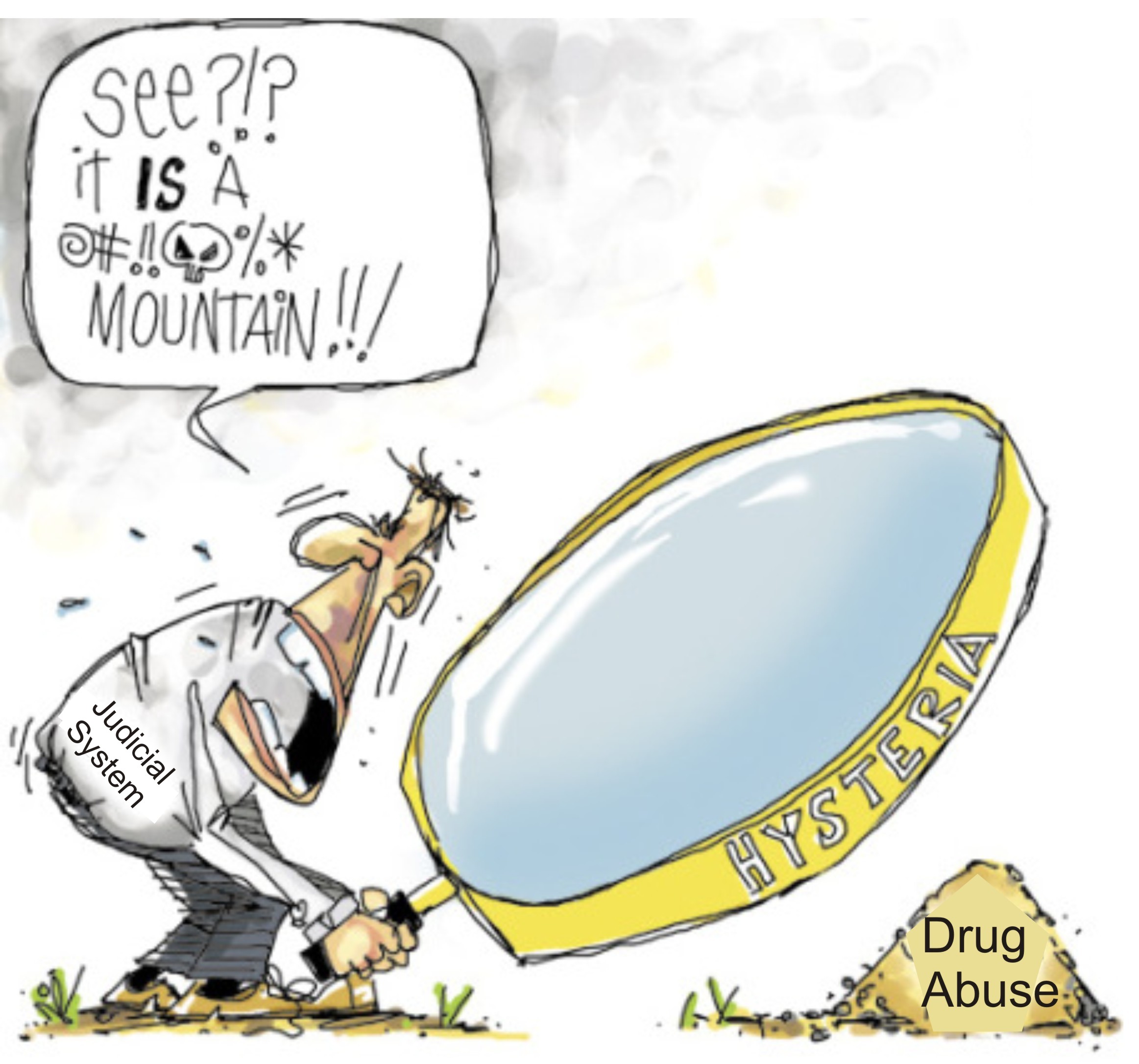
election year politics.. and they claim that there is intelligent life on this planet

lmaoLawmakers try to outdo each other on heroin epidemic

http://www.usatoday.com/story/news/politics/2016/02/11/lawmakers-try-outdo-each-other-heroin-epidemic/80249502/

We spend at least 51 billion trying in fighting the war on drugs and keeping abt 2 million serious substance abusers from abusing legal/illegal drugs.. that is about $25,000 per capita…. and we spend some $9,000 per capita for all healthcare in this country.  Some in Congress believes that we can resolve this “epidemic” by committing abt $300 per capita to provide treatment and prevention to get all those substance abusers back on the “right track”. We have spent > ONE TRILLION DOLLARS since we officially declared the war on drugs in 1970. We now have EIGHT TIMES the number of people working for the DEA than 1970 and untold numbers of law enforcement at city/county/state level fighting this war on drugs.  That 600 MILLION EMERGENCY SPENDING BILL is 0.002% of what we now spend annually fighting the war on drugs.  Election year politics… are the politicians that stupid or is the electorate that stupid to believe this ?   Unfortunately, they are both true 🙁

WASHINGTON — Is the heroin epidemic becoming a political football? It started to look that way in the Senate on Thursday, as Republicans and Democrats tried to one-up each other with legislative proposals aimed at addressing the crisis.

First, Republicans greased the legislative skids for a treatment-and-prevention bill championed by Ohio Sen. Rob Portman — one of the Senate’s most vulnerable GOP senators in the 2016 elections. The Senate Judiciary Committee approved the legislation Thursday morning, and Portman said Majority Leader Mitch McConnell, R-Ky., promised him a quick Senate floor vote on the bill.

“This is for real,” Portman told Ohio reporters after the committee vote. “This will make a difference in the lives of the people who I represent.”

An hour later, Senate Democrats said the Portman-backed bill was a great first step, but without money attached, it wouldn’t make a significant dent in the epidemic. They called for a $600 million “emergency spending bill” to fund prevention, treatment, and recovery programs.

“We don’t want to just have a little fig leaf out there,” said Sen. Charles Schumer, D-N.Y. “All the rhetoric in the world isn’t going to help expand access to naloxone and prevent overdose deaths. Endless Senate speeches won’t mean more beds in treatment centers.”

The dueling press events hint at a potential showdown over the heroin crisis. Even as lawmakers say the opioid epidemic should be a bipartisan issue, because it has hit every geographic and demographic corner of the country, they are competing to take credit for offering the most aggressive and effective response.

Advocates say they welcome the attention, even if it is driven by political considerations ahead of the 2016 elections.

“For a number of years, many lawmakers looked the other way,” said Grant Smith, deputy director for national affairs at the Drug Policy Alliance, which advocates for treating addiction as a public health issue instead of a law enforcement problem. “They didn’t even want to say the words ‘drug overdose,’ even though tens of thousands of people were dying.”

” … So if this is in fact becoming more political, in a way I would welcome that,” Smith said. “It shows there’s an eagerness to get something done on this issue.”

That eagerness was on full display Thursday, as the Senate Judiciary Committee unanimously approved the Comprehensive Addiction and Recovery Act, or CARA. That bill, sponsored by Portman and Sen. Sheldon Whitehouse, D-R.I., among others, would:

• Authorize grants to states, local governments, and nonprofit groups for education and prevention efforts to combat opioid and heroin abuse

• Promote funding alternatives to incarceration for those with substance-abuse problems

• Expand first-responders’ access to naloxone, a medication that can reverse the effects of an opioid overdose

• Launch a demonstration program using medication-assisted treatment, a highly effective regimen for opioid addicts

“Over 20 people will die this week in Ohio” from opioid overdoses, Portman said. “This is a chance for the federal government to step up and be a better partner.”

The measure, which enjoys broad bipartisan support, could come up in the full Senate later this month. Although the bill calls for devoting as much as $80 million to treatment, prevention, and recovery, CARA does not include any actual money. That would have to come through an appropriations bill.


Enter Schumer and other Democrats, who plan to offer their emergency funding bill as an amendment to the CARA bill when it comes up for debate.

“This is a national health emergency and we need a federal response to address it,” said Sen. Jeanne Shaheen, a Democrat from New Hampshire, which has been hard-hit by the opioid crisis. Her bill would increase funding for existing federal and state programs.

It would, for example, send $225 million to the states to expand prevention, treatment, and recovery programs. It would provide another $200 million for state and local law enforcement programs, including drug treatment and education.

The CARA bill makes good policy changes, Shaheen said, but Congress needs to send money to treatment providers and first responders who are on the front lines of the epidemic. She noted that in 2009, Congress appropriated more than $2 billion to combat the swine flu epidemic. And in 2014, lawmakers approved $5 billion for Ebola, which only killed one person in the U.S. That same year, 47,000 Americans died of drug overdoses.

“We are not going to get … this under control unless the federal government steps up and provides resources,” she said.

Schumer, who is in line to become the Senate’s majority leader if Democrats regain control of the Senate, essentially dared Republicans to oppose the extra money. He accused Republicans of talking a good game on the heroin epidemic and other issues, but suggested their motivations might be political.

Republicans offer legislation to authorize increased spending and “put the names of senators who are up for re-election on them,” Schumer said, but they don’t follow up with real dollars when it comes to approving spending bills. “We are here to hold their feet to the fire,” he said.

Portman noted that Schumer is a co-sponsor of the CARA bill and he voted for it Thursday. Asked whether he would support the additional money, Portman said it was important to pass the CARA bill first, and that would lead to increased funding.

“I’m not against more funding,” Portman said. But CARA will provide “a new framework for how you spend the money,” making sure it goes to effective programs that steer addicts away from prisons and into treatment, among other changes.

Tonda DaRe, an Ohio mother who testified in support of the CARA bill at a Judiciary Committee hearing last month, said she is thrilled lawmakers are scrambling to offer solutions to the epidemic. DaRe, who lost her daughter to a heroin overdose, said it would be “fantastic” if Congress approved both the policy changes and the increased funding.

“Somehow, somewhere all of a sudden this is on everybody’s radar,” she said. “I’m thankful for that. Hopefully there will be many less lost children.”

If you are substance abuser.. best place to have a job … LAW ENFORCEMENT

Deal cop suspended on suspicion of drug use before death

http://www.app.com/story/news/crime/jersey-mayhem/2016/02/26/breaking-deal-cop-killed-crash-had-been-leave-following-suspicion-drugs/81004310/

Capt. Earl Alexander IV was off duty since August, chief said

The Deal police captain killed in a crash Jan. 2 — who was found to have drugs and alcohol in his blood at the time he died — had been suspended with pay since August 2015, according to Chief Ronen Neuman.

Neuman couldn’t say what triggered the internal affairs investigation, other than confirming authorities had reasonable suspicion Capt. Earl B. Alexander IV was using drugs. The Deal Police Department doesn’t randomly drug test police officers, according to Neuman.

“At the end of the day,” he said, “whatever happened, it was his doing and he hurt himself and it cost — he paid the ultimate price for his negligence.”

READ: Deal police captain impaired in fatal crash

Alexander, 38, died when he lost control of his 2007 Acura TSX and hit a utility pole on Norwood Avenue near Perrine Avenue in Ocean Township. The official toxicology report following his death showed a dozen chemicals — including illegal designer drugs commonly known as “bath salts” — and more than twice the legal limit of alcohol in his blood.

While the Attorney General’s Office mandates that police departments test new hires and test when there is reasonable suspicion of drug use, the policy says departments “may” choose to implement a random drug testing program.

A copy of the borough’s policy shows random drug testing is required for employees who have a commercial drivers license or whose service contracts require random testing.

Alexander’s blood showed signs of a prescription antidepressant sold as Lexapro, prescription sleep medication sold as Ambien, and amphetamine, which can be prescribed to treat attention deficit hyperactivity disorder or narcolepsy, though it wouldn’t normally be prescribed in combination with the other two legal drugs, according to Dr. Lawrence J. Guzzardi, a doctor who reviewed the report for the Asbury Park Press.

Deal police policy dictates that an officer has to notify the department if they’re taking prescription medication. Neuman said this involves an officer providing him with a prescription for the medication.

He said the department didn’t receive any prescriptions from Alexander.

READ: Police officers from Deal, Brick mourned

Neuman said he is considering implementing a random drug testing policy. But he wouldn’t change any other policies. He said the department was reaccredited by the state about a year ago.

“We have model policies,” he said.

He expressed a mixed opinion on random testing.

He agreed that “of course” random drug testing would be a deterrent for officers who might consider taking drugs.

But he also expressed doubt.

“I don’t think it really weeds out — cause if you check a few guys — at the end of the day, if we do a test today, the guys know probably for a few months you’re not going to have a test,” he said.

“At the end of the day, it’s not the random drug testing, it’s the other officers on the street that are telling you what’s going on.”

READ: Brick police announce death of officer battling cancer

Joseph J. Blaettler, a former deputy chief of police for Union City who testifies in court as an expert witness on police policy, said it’s common for departments to have a protocol for random testing, but it often isn’t used.

“I believe very few departments actually do random testing,” he said.

He described random testing as a useful tool. He said more people struggling with substance abuse might seek help if they knew their department did random testing.

“Would it be wise for the attorney general just to mandate the policy? Probably. Because without the mandate, a lot of police departments are just not going to do it on their own.”

He pointed out that in New Jersey if an officer has a substance abuse problem and seeks help, the department won’t discipline or fire the officer.

“I would urge any police officer that knows he has a problem or she has a problem, whether it’s alcohol or drugs, go to your employee assistance program immediately,” he said.

Police investigated where Alexander might be getting drugs, but Neuman said, “nothing came of it.”The department launched a second internal affairs investigation after the crash that killed Alexander, as they would anytime an officer is involved in a crash, according to Neuman. Both that investigation, and the one into Alexander’s suspected drug use, remain open. No other members of the department have been implicated, according to Neuman.

READ: Funeral arrangements set for Deal police captain

Following the fatal crash in another jurisdiction, Neuman said the Monmouth County Prosecutor’s Office would be responsible for looking into where Alexander got the drugs found in his blood.

First Assistant Prosecutor Marc LeMieux said the case of Alexander’s crash was closed.

“This was a motor vehicle accident and there was no criminality to this accident,” he said.

Neuman said he hadn’t disciplined Alexander inbefore the August suspension and that Alexander had no record of substance abuse issues.

“Absolutely not,” he said. “That’s the sad part about this whole case, is that he was a model officer, he moved up to the rank of captain, for a few years he hasn’t even used a sick day.”

Stephen Carasia, borough administrator and former police chief of almost five years, also said he was “absolutely not” aware of Alexander abusing drugs or alcohol.

With Alexander’s death, Neuman lost his right-hand man. They went to Ocean Township High School together, they started out as patrolmen together, they rose through the ranks together. As administrators of the 17-officer department, they ran day-to-day operations together.

Carasia said Alexander entered the department as a dispatcher. He was hired May 1, 1998. He was appointed as a class II officer in 1999.

“Throughout his whole career, he was definitely a good officer,” Carasia said. “He loved his job, was always here, always working, always ready to work when he was called upon.”

Neuman said Alexander once stopped a suspected bank robber while off-duty.

In addition to his position with Deal police, Alexander served as assistant chief of Deal Fire Company 2, was the former chief of the Oakhurst Fire Department and was a volunteer with both first aid squads.

Neuman said he would respond to calls in the middle of the night.

“If there was a first aid call at 2, 3, 4 in the morning, a fire call, he’d come to work,” Neuman said, “And he’s like: ‘you know that fire you saw on TV, I was there til 5 in the morning, I was there til an hour ago.’”

Neuman said he once saved a woman’s life by performing CPR.

“At the end of the day, you’ve got to judge every person on his own character,” Neuman said. “You can’t judge me because someone in my department did something wrong. Every business has got someone that’s not doing the right thing and we try to address it every day. And no one’s perfect.”

Andrew Ford: 732-643-4281; aford3@gannettnj.com

Best place to have a job when you are a criminal – LAW ENFORCEMENT ?

DEA task force member arrested by state police in drug probe

http://www.wwl.com/DEA-task-force-member-arrested-by-state-police-in-/22512462

Louisiana State Police have arrested a second investigator assigned to a U.S. Drug Enforcement Administration task force.
 
Maj. Doug Cain, a State Police spokesman, says they are scrutinizing cases made by the task force officers where drugs and cash seized in raids disappeared or were never recorded as evidence.
 
Cain says 49-year-old Karl Newman, a longtime deputy with the Tangipahoa Parish Sheriff’s Office, was booked Thursday on counts of conspiracy to distribute cocaine and abuse of office.
 
Cain says Newman is being held without bail in the St. Tammany Parish Jail.
 
Cane says the arrest comes a month after troopers booked Johnny Domingue, another Tangipahoa Parish Sheriff’s Office deputy who had been assigned to the DEA task force.

A mental health epidemic ?

CABELL COUNTY, W.Va. (WSAZ) — A WSAZ investigation into the heroin epidemic in Cabell County quickly went viral. Now, we are following up with the young man shown overdosing and the paramedics who saved him in that shocking body camera video.

In WSAZ Investigates: A Dose of Reality, 26-year-old Joey overdoses on heroin in his Barboursville home. His mom calls 911, and Cabell County EMS Supervisor Chad Ward arrives on scene first.

Chad’s body camera is rolling as he finds Joey lying on his bed, turning blue and only breathing twice a minute. He is just minutes from death. More paramedics arrive and they give Joey Narcan, a drug that reverses an overdose.

In just a matter of minutes, Joey is awake and walking. The dramatic scene is shown through the eyes of Chad — a scene he and his paramedics see every single day.

“I want these people to know, you were on death’s door,” said Chad. “I know it doesn’t seem like it now, but truly you were. Another five or 10 minutes could have made a big difference.”

After the story first aired, it went viral. The web article was viewed more than 300,000 times in just a couple of days. The story was also featured on national websites, was the number one story in the news section of Reddit, and was shared thousands of times on social media across the country.

“I never believed it was going to get that big,” Chad said. “When you get a story and it gets out that big, maybe it helped one person to quit doing heroin — decide, ‘This is not for me. I don’t want to risk it.’ Or maybe it helped one person to say, ‘I’m never going to try heroin. I see what it can do.’ Either way, if we helped one person, it was a great story. It was worth it.”

One person the story did help is Joey. After the story aired, Joey posted a message to his friends and family on Facebook explaining that he planned on seeking help and going to rehab.

“I can’t continue to live this way anymore,” said Joey’s post. “I want better things to happen in my life and if I continue on the path I am in, I will be dead. Time to improve my life.”

After our story aired, he posted again, saying he didn’t give us permission to use the video for attention, but to bring awareness to the drug epidemic. He wants to help other people who are struggling.

Joey’s sister also spoke to WSAZ, saying the story was a wake-up call for her brother.

“I hope and pray this opens people’s eyes,” said Emmi, Joey’s sister. “Thank you, Kaitlynn LeBeau, for doing this documentary. Hopefully it’s saving lives.”

Chad said he is glad to see the video is eye-opening for Joey and his family.

“It is a wonderful feeling to that that OK, we did this story and now this young man might get some help, might get past this addiction,” Chad said. That just feels good — there’s no other way to put it.”

Chad, Joey and Emmi all say they hope this story continues to make a nationwide impact — showing the reality of the heroin problem and that there are real people behind the overdose statistics.

“I hope people keep seeing it; I hope it changes people,” Chad said. “Anything we can do that is going to eventually help is what we need to be doing.”


ORIGINAL STORY 2/11/16
CABELL COUNTY, W.Va. (WSAZ) — A 911 call comes in to Cabell County EMS. The caller is a worried mother. She just found her son unconscious in their Barboursville home. He’s turning blue and barely breathing. A used needle lays on the floor next to his bed. He is minutes from death.

The first to arrive at the home is EMS supervisor Chad Ward. His body camera is recording the disturbing but familiar scene.

“A lot of times you’ll hear people refer to Huntington as Little Detroit,” said Chad. “I never believed we’d be treating 2 and 3 heroin overdoses a day. Never.”

It’s a cold Sunday night. Chad arrives and is greeted at the door by Mary.

“He might be dead,” said Mary. “I have no idea what he took.”

Chad is calm. He’s responded to a heroin overdose dozens of times before. He enters a back bedroom and sees Joey unresponsive on the bed.

“Alright, honey, let me work with him,” Chad reassures Mary.

The body camera scans the room — Chad is looking for the needle Joey used to shoot up. He finds it on the floor and tells Mary not to touch it.

“Just leave it there; just leave it there,” Chad tells her.

He moves Joey on to the floor and begins giving him oxygen. Joey’s heartbeat is strong, but he’s only breathing twice a minute. Chad is working against the clock.

This is a normal day for Chad and his paramedics.

“I don’t know what brings anybody to it,” Chad tells WSAZ. “Anxiety, depression, just looking for something to do. It’s hard to say. But it is truly everywhere.”

In 2015, there were 944 drug overdoses in Cabell County. That’s up more than 300% from 2014.

944 reported overdoses in 2015
272 reported overdoses in 2014
256 reported overdoses in 2013
146 reported overdoses in 2012

Out of the total number of overdoses, 70 proved fatal — the deadliest year the county has seen for drug overdoses. Chad fears 2016 will be just as grim.

“I think it’s going to get worse before it gets better,” said Chad. “And honestly, I don’t know what will make it better.”

He also worries that the staggering numbers pack little punch now-a-days. He understands why, though. He has responded to 7 overdoses in one day. Some of his paramedics have responded to as many as 14 in one day of work.

“Every day that we go on an overdose, I just think oh my goodness, here we go again, here we go again, here we go again,” said Brenda Johnson, a Cabell County paramedic.

Brenda has been a paramedic for Cabell County for 14 years. When she started her career, she had no idea how many of her patients she would be treating for an overdose.

“Once they start using it then it’s hard to let go of it,” said Brenda.

But it’s not just addicts, she said. It can be a gamble for first-time users — especially if the heroin is laced.

“It may be a situation where they’re going to try it one time, you know just that one time, but they don’t realize that one time could be the last time they try it,” said Brenda.

Some of the additional drugs that heroin can be laced with are incredibly dangerous and even lethal.

“It will literally just kill them in a matter of minutes,” said Chad. “Some of these drugs are mixed with light fluid and phosphorus and things you would never dream about putting in your body.”

About four minutes have gone by when more paramedics arrive to help Chad. They immediately begin prepping Joey for Narcan — a drug that reverses an overdose.

“Everybody’s heard about Narcan and what an amazing drug it is and literally it will take somebody from the edge of death to back alert and oriented just like we’re talking now,” said Chad.

But although Narcan saves lives, and could save Joey’s, Chad and many of his paramedics say it’s creating more concern than comfort for them. Brenda says Narcan is giving drug users a false sense of security.

“That scares me because I’m afraid the people who are using or abusing these drugs are going to get into the mindset of, ‘Well, somebody’s going to have Narcan. It’s going to be close by so I’m okay. Even if I overdose, somebody’s going to save me,'” said Brenda. “You know, some we can save, some we can’t.”

The paramedics give Joey Narcan. Less than a minute and a half later, Joey takes a deep breath. He’s awake and the paramedics begin asking him what drugs he took.

“Heroin — did you shoot heroin?” Chad asks.

“A tiny bit, yeah,” Joey responds after some hesitation. The paramedics have to reassure Joey that they are not the cops and are there to help — something they have to do often on overdose calls, Chad said.

“Now, Joey, listen to me man,” Chad says as Joey stands up. “About ten more minutes, you’d be dead. I’m not kidding you, I’m not lying to you, I’m not trying to scare you. Somebody hadn’t been here about 10 more minutes, you’d be laying there dead as a doornail right now.”

Joey has a second chance at life, but the paramedics know for as many people as they save, there will be another overdose.

They just saved someone’s child, but Chad says one of the most heart-breaking experiences is interacting with children who have found their parents unresponsive.

“It’s harder to deal probably with the children and try to make them understand and comfort them than it is to deal with the patient themselves,” said Chad. “You’re trying to comfort them. You’re trying to tell them and they’re, ‘What’s going on? Is mommy dead?’ And you know, depending on the situation, you have to try to explain to these children at their level what’s going on. You know, that they’ve taken something bad it looks like and we’re going to try to help em out and make ’em well again.”

The same calls stick with Brenda.

“That to me is very disheartening, that’s very disheartening,” said Brenda. “To think that you would have small children in your house that are depending on you to keep them safe and then this person is engaging in that kind of activity. But here, again, it’s an addiction.”

Chad has responded to homes where an entire family has overdosed: Mother, father and son.

“I walked in and thought, how does one family, the entire family, get involved in this?” said Chad. “What’s going on in their lives that they think this is good for everybody?”

Many of the calls they go on are for patients they have treated for an overdose before. After saving their lives with Narcan, they just begin using again.

“It’s kind of sad when you roll up on a scene and look at somebody and you know immediately who they are because of the fact that you’ve picked them up before for a drug overdose,” said Brenda.

As more people become addicted, Brenda and Chad say there is yet to be a real solution to the problem.

“I don’t see it slowing down any time soon,” said Chad. “I only see it getting worse.”

“The only solution is to educate as many people as we can about this epidemic and get the people who are using drugs treatment,” said Brenda.

The family featured in this story did not want to be interviewed, but gave WSAZ permission to show the video.

more people are going through withdrawal – and turning to heroin

Labeling the sharp rise in prescription drug abuse an ‘epidemic’ has made the problem WORSE, expert warns

http://www.dailymail.co.uk/health/article-3465991/I-ve-never-seen-patients-heroin-Labeling-sharp-rise-prescription-overdoses-epidemic-problem-WORSE-experts-warns.html#ixzz41LNV7aMi

  • The Centers for Disease Control has labeled opioid abuse ‘an epidemic’
  • But, a top pain expert warns that label is leading to increased heroin use
  • Doctors are now taking patients off painkillers abruptly, he says
  • And so, more people are going through withdrawal – and turning to heroin 

Health experts in the US have labeled prescription painkiller abuse an ‘epidemic’.

The Centers for Disease Control and Prevention (CDC) were moved to do so after noting a sharp rise in opioid overdoses.

But that move, some say, is in fact making the situation worse.

One top pain management expert has argued the ‘epidemic’ label is aggravating the issue, and is causing patients to turn to heroin instead.  

Dr Vitaly Gordin, division chief of chronic pain management at Penn State Hershey Medical Center, said he has never seen so many inpatients on heroin, as in the last six to 12 months.

‘Because of this declared epidemic, many primary care physicians, specialists and surgeons are taking these patients off the narcotics,’ he said.

‘But if they don’t have an exit strategy and get referred for alternate treatment, addictions counseling or rehabilitation, they can become desperate as they go through withdrawal.’

The CDC has labeled abused of prescription painkillers in the US as 'an epidemic' - but a top pain expert warned that the label is making it worse. That's because doctors are now taking people off of the narcotics

The CDC has labeled abused of prescription painkillers in the US as ‘an epidemic’ – but a top pain expert warned that the label is making it worse. That’s because doctors are now taking people off of the narcotics

Prescription painkillers – such as oxycodone and tramadol – are opiate analgesics, just like heroin.

Those painkillers are frequently prescribed for pain control.

Many people who are prescribed the pills to relieve short-term acute pain – such as the pain that occurs following surgery – are not at risk of addiction.

Dr Gordin said: ‘The vast majority of them will very easily get off these medications as their condition improves and pain is decreasing.’

Similarly, painkillers are also often prescribed to patients suffering from chronic conditions.

I have never seen as many inpatients on heroin as I have in the past six to 12 months
Dr Vitaly Gordin, of Penn State Hershey Medical Center

Those patients require high doses of narcotics for long periods of time.

Dr Gordin said: ‘There are a lot of very legitimate patients who are receiving these medicines in a chronic setting who are not abusing them.’

However, the risk sets in when someone is taken off the medication after using a high dose for a long period of time.

For some of these patients, if they aren’t able to renew a prescription for narcotics, they may turn to heroin while going through withdrawal.

Heroin is relatively inexpensive and easier to access illegally than prescription medications.

But unlike prescription painkillers – which are regulated by the Food and Drug Administration – heroin has no regulation.

And so, it is hard to verify what is in the heroin a person buys from a dealer.

Dr Gordin said: ‘Several years ago there was a string of deaths of addicts who bought heroin laced with a potent painkiller called fentanyl.

When people who have been taking painkillers long-term are abruptly taken off the drugs, they start to go through withdrawal - and may end up turning to heroin (pictured) instead

When people who have been taking painkillers long-term are abruptly taken off the drugs, they start to go through withdrawal – and may end up turning to heroin (pictured) instead

‘Because it’s all underground, illegal business, you don’t know what exactly you’re getting.’

Nearly 20,000 deaths occur each year from prescription opioid abuse.

Most of those deaths happen when the narcotics are taken with another substance – such as benzodiazepine or alcohol.

 There are a lot of very legitimate patients who are receiving these medicines in a chronic setting who are not abusing them
Dr Vitaly Gordin

Such combinations can be lethal, according to Dr Gordin.

The doctor noted that patients with a history of drug abuse, untreated psychiatric conditions or a history of pre-adolescent abuse are more likely to develop addictions.

Dr Gordin said: ‘In my 17 years working here, I have never seen as many inpatients on heroin as I have in the past six to 12 months.

‘Those who have abused heroin are getting into car accidents or involved in violent crimes because of being on the drug or trying to obtain it.

‘I think it’s directly related.’

The doctor suggested that society start removing the stigma of addiction – and stop thinking of it as a character flaw.

Dr Gordin said: ‘We need to understand it is a disease with psycho-social components, and we need to have resources available to both prescribing physicians and patients who need drug rehabilitation

Alcohol sales to benefit mental health?

stupidcanyoube

http://www.jconline.com/story/news/college/2016/02/26/alcohol-sales-benefit-mental-health/80991716/

Purdue’s Counseling and Psychological Services (CAPS) needs more funding to meet the need of a rising rate of students seeking mental health care.

The undergraduate student government thinks selling alcohol at sporting events could help.

In 2015, CAPS saw a 15 percent increase from the previous year in the number of students who sought an appointment, Purdue Student Government President Mike Young said in a presentation to the Board of Trustees Friday.  About 100 students will be on a wait list in a given week.

The center has 17 full-time employees, which Young said is eight fewer staff members than the International Association of Counseling Services recommends.

Young proposed the university hire additional CAPS clinicians and up resources to meet those recommendations and reduce the wait time for appointments. He suggested to partially fund the $682,200 plan with alcohol sales from sporting events.

“A lot of these ideas, like the more off-the-wall things, kind of sound unfeasible or ridiculous at first,” he said, “but then you start to look at it and this could be a double-win for students, in my opinion.”

Purdue started allowing season ticket and VIP card holders to purchase beer and wine at the Ross-Ade Stadium’s South End Zone Patio in 2014, but fans currently can’t purchase or drink alcoholic beverages outside the gated area or private suites. The general public also can’t buy drinks at other sporting events.

Young said he got the idea from the University of Maryland’s student government, who successfully campaigned in 2015 for the school to sell alcohol at games and use the funds for student support services like mental health counseling. The school projected the sales would hit $500,000 annually.

Purdue President Mitch Daniels said additional mental health resources are probably needed and he’ll take a look at the proposal.

“We’re going to take it very seriously,” he said.

 Other items discussed at the meeting

  • Purdue Graduate Student Government President Andrew Zeller proposed a 3.5 percent increase to all general fund teaching assistant lines for Fiscal Year 2017, the same increase implemented last year.
  • Board approved plans to move forward with a $6.25 million Controlled Environment Phenotyping Facility.
  • University Senate Chairman Kirk Alter presented a resolution for collaborative decision-making with Purdue leaders while the University Senate and regional campus Faculty Senates are in session.
  • PSG President Mike Young also requested a permanent funding solution for Student Legal Services.


CDC GUIDELINES… do practitioners consider all of these mandatory.. like a law ?

http://www.cdc.gov/vaccines/hcp/acip-recs/index.html

Here is a link and the list of all the CDC’s vaccination recommendations. I wonder how many practitioners consider these “guidelines” mandatory to follow…  If a pt refuses/declines to get a flu shot…  should the practitioner be held responsible for not following these guidelines ?

Believe it or not the CDC … does not keep stats on flu deaths.. they just estimate them   http://www.cdc.gov/flu/about/disease/us_flu-related_deaths.htm

That estimate ranges from 3,000 to 49,000 per year. So have practitioners, prescribers and pharmacists been negligent for failing to make sure that each and every pt gets a flu shot EVERY YEAR… that means that there is up to 49 K UNNECESSARY DEATHS..  That is as many claimed deaths from drug overdoses.. which includes drug overdoses from OTC’s. Should practitioners, prescribers, pharmacists be held liable for some of these deaths ?

For those of you with chronic pain  and your practitioner or pharmacist tell you that the new CDC “GUIDELINES” on opiate dosing is the NEW LAW OF THE LAND… You might want to consider challenging them as to if they are absolutely following the OLD CDC guidelines on vaccinations.. and if not… are they discriminating against those who have a valid medical necessity for being prescribed opiates ?… the same pts that are covered under The Americans with Disability Act and a violation under that act is a civil rights discrimination ?

Those who wish to live by the rule book… could find out that they may end up dying by the rule book.  Either all the rules are in concrete or none of the rules are in concrete… Liking/enforcing some rules.. and ignoring/not enforcing other rules.. does not CUT IT !

I wonder how many other guidelines that the CDC has formulated and published and they are not universally being adhered to and no one is being held responsible for consequences/deaths for not following them ?

Vaccine-Specific ACIP Recommendations

To prescribe opiates to treat chronic pain is really old school medicine

DEA investigates three central Indiana pain clinics

http://fox59.com/2016/02/26/dea-investigates-three-central-indiana-pain-clinics/

If I was a news reporter… I would always seek out an addiction counselor ( with no medical background)  for medical advice on treating chronic pain.

INDIANAPOLIS, Ind (Feb. 26, 2016)–Three central Indiana pain clinics were searched by federal and local agencies Friday morning.

Sources tell FOX59 the Pain Management Centers of Indiana are being investigated for the alleged overprescribing of pain medications possibly linked to overdose deaths.

The investigation is spearheaded by the Drug Enforcement Administration along with local agencies in Marion, Miami and Monroe counties. The prosecutors from all three counties are  assisting  along with The Indiana Attorney General.

Records and files were removed in evidence boxes from the clinics. They operate in locations in Peru, In, Bloomington, In and the south side of Indianapolis.

The main physician’s home was also searched in addition to the three practices.

According to the Miami County Prosecutor’s office, the investigation was sparked in part by individual complaints.

“It is the duty of DEA, the Attorney General and the prosecuting attorneys to investigate such complaints. Whether or not they are substantiated by the evidence being gathered and reviewed may not be determined for several weeks,” said Bruce Embry, prosecuting attorney for Miami County.

Addiction counselor Scott Watson says these investigations are key in holding physicians accountable.

“To prescribe opiates to treat chronic pain is really old school medicine. There are better ways to treat chronic pain than to simply push more medicine at those patients​,” said Watson.

FOX59 is withholding the doctor’s name because criminal charges have yet to be filed.

A Leopard can’t change its spots

Law Enforcement and Pain Patients

http://www.painnewsnetwork.org/stories/2016/2/25/law-enforcement-and-pain-patients

http://www.naddi.org/aws/NADDI/pt/sp/home_page

http://www.pharmacytimes.com/search?get1=search&keywordType=relevancy&keywordTerm=burke&x=0&y=0

The first link is to a article written by John Burke.. recently retired from a 48 yr career in law enforcement.. he would have started just before Congress passed The Controlled Substance Act in 1970 that eventually morphed into our “beloved” DEA of today.

The second link is to the organization that John Burke help founded/lead …. National Association of Drug Diversion Investigators

and currently President of  International Health Facility Diversion Association.

The third link is to PHARMACY TIMES that John Burke wrote a monthly article for years in the magazine.

I had Barb read the article he penned on painnewsnetwork and she came back believing that it was a nice article.. then I reminder her that this was the same person that I had written a letter to PHARMACY TIMES about Burke’s monthly opiophobic rant after one month he basically accused many “grandma types” getting opiates so that they could sell them to supplement their income… My letter to PHARMACY TIMES said it was time to pull Burke’s opiophobic rants… of course, PHARMACY TIMES never bothered to respond to my letter and continued to published Burke’s opiophobic rants…  You can go to the third link to see some of these rants published monthly in PHARMACY TIMES.

If you come to the same conclusion that I did.. Burke writes to the anticipated readership.. I have seen this from him at least once before in a article penned by him that was directed to the  chronic pain community.

IMO… Burke’s head/heart belongs to law enforcement and typifies a “wolf in sheep’s clothing “


History repeats itself … stupid people pass stupid laws

dumbpeople

Stopping Drug Dealers

cell

The Indiana General Assembly is focused on ways to reduce the illegal drug epidemic in Indiana. Part of our strategy includes tougher penalties for the dealers who fuel drug abuse in our communities.

House Bill 1235 would establish mandatory minimum sentences for the worst drug dealers. Under this bill, the sentence for the highest felony level of dealing meth or heroin with a prior dealing conviction could not be suspended below 10 years.

Additionally, Senate Bill 290 would allow courts to convict people in possession of large amounts of drugs as dealers, not just users.

These bills would work together to stop drug dealers in our state.

If these Indiana legislators would come out of the mid-20th mindset that they are apparently stuck end and WAKE-UP that as long as we have people suffering from the mental health disease of addictive personality disorder that are UN-diagnosed, under treated or untreated and have elected to self medicate the demons in their head and/or monkeys on their back with some substance… sometimes alcohol, sometimes opiate based substances or whatever their substance of choice is… there will be someone who tries to make a buck to sell those people whatever substance they want or can afford to abuse. To quiet those monkeys and/or demons.. and after a few years when they have developed a large tolerance … they no longer get much of a high.. they just end up trying to fight off the suffering of going into withdrawal. If we chose to treat those with mental health issues… the dealers on the streets would not have any customers…no customers.. no profits… sells substances that can be abused… I guess that concept is just too complicated for Indiana’s legislators and most other states’ legislators and bureaucrats.  Cause they all seem to have the same delusion of stopping substance abuse.. except Tobacco , Alcohol and Gambling.. because they impose a “sin tax” on those products… Addictions are ok as long as the bureaucrats get their “take” of the action ???