





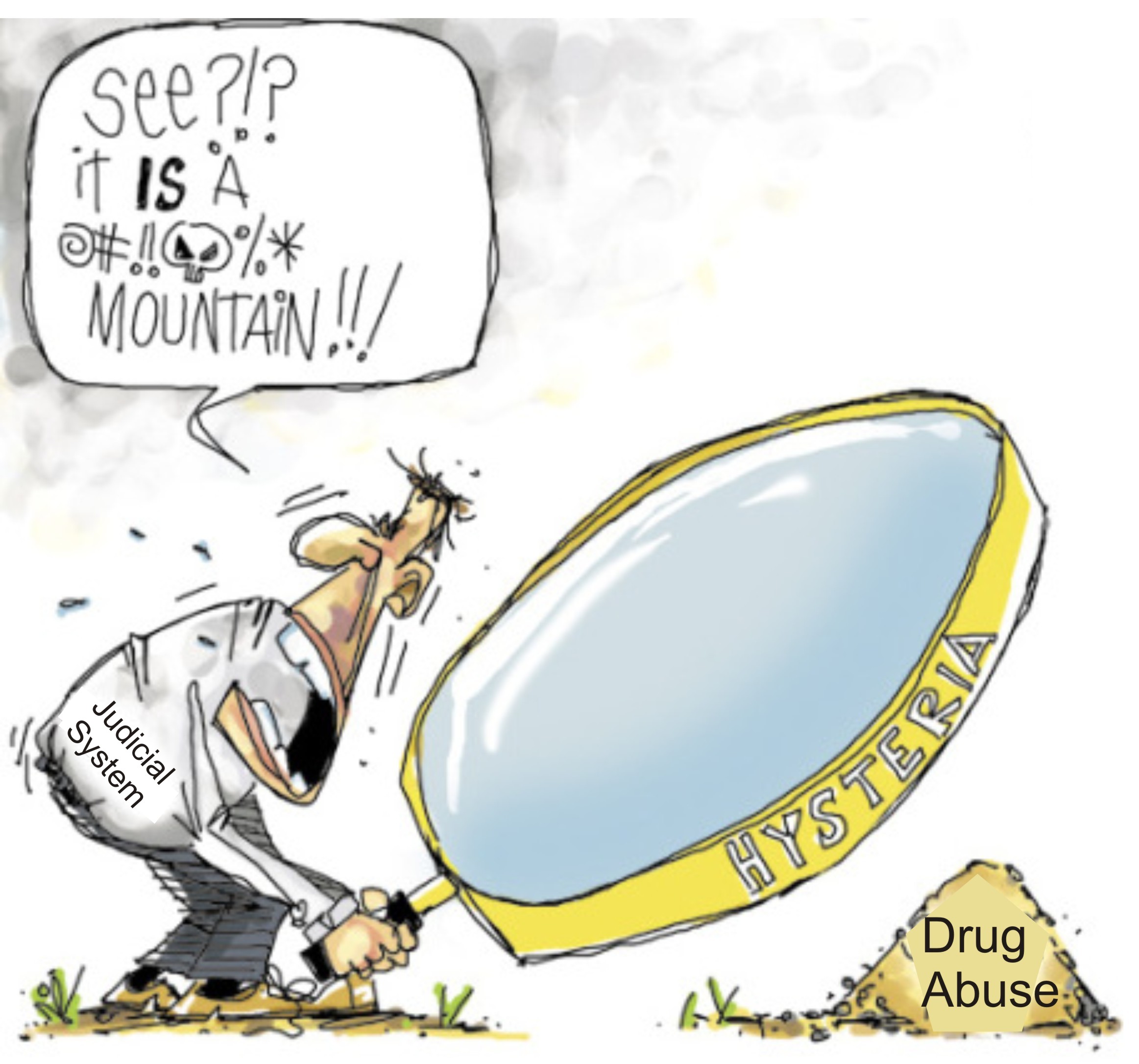


Across healthcare systems worldwide, few phrases carry as much quiet authority as “drug-seeking.” It is not a diagnosis. It does not appear in ICD-10, ICD-11, or DSM-5. It has no objective criteria. Yet once applied, it transforms the clinical encounter. Symptoms are reinterpreted as suspicion. Requests become moral signals. The person seeking help is no longer a patient or client, but a subject to be managed. This matters because labels do not merely describe reality — they enforce it.
“We know better than you”
What we are witnessing in restrictive prescribing cultures is not simply clinical caution. It is something older, more ideological, and more familiar to history. Modern prohibitionist prescribing practices increasingly resemble a form of soft colonialism: a civilising mission conducted through clinical language, moral certainty, and institutional power. The prescriber becomes the missionary. The policy becomes doctrine. The patient becomes the native to be corrected. Today’s “new missionaries” do not arrive with Bibles and flags. They arrive with guidelines, risk frameworks, and safeguarding rhetoric. They speak in the language of care, safety, and evidence, while quietly imposing a moral hierarchy of acceptable suffering. Benzodiazepines, gabapentinoids, and opioid analgesics are framed not merely as medicines with risks, but as symbols of moral failure — weakness, dependency, regression. Those who request them are cast as unreliable narrators of their own experience, requiring discipline rather than care. This is not neutral medicine. It is moral governance. Like all colonial projects, it rests on a simple premise: “We know better than you.”
Colonial patterns in modern prescribing
Colonial systems were characterised by several recurring features: – The belief that local knowledge is inferior to imported expertise – The redefinition of need as pathology – The use of bureaucracy to enforce compliance – The portrayal of control as benevolence. Restrictive prescribing reproduces each of these patterns almost perfectly. Lived and living experience is discounted. Long-term patients, people with chronic pain, trauma, or substance use histories are treated with suspicion. Their testimony is tolerated only insofar as it aligns with institutional doctrine. Clinical discretion is replaced by policy orthodoxy. “We do not prescribe” becomes a moral boundary rather than a clinical judgement. Prescribers are absolved of relational responsibility by adherence to rules they might not have written but are rewarded for enforcing. “I am only doing my job” and variations on it, are familiar to anyone who studies colonial history.
“Hope springs eternal in the human breast”
Drug and alcohol treatment services are not immune from this, yet there are rare and quietly courageous exceptions — places that resist colonial instincts and remain faithful to the lived reality of patients and service users. In those spaces, hope does indeed spring eternal, as An Essay on Man reminds us: “hope springs eternal in the human breast.” May that hope be answered in 2026 as more places and more providers return to compassion over self-preservation, care over compliance, and service grounded not in control or expansion, but in the simple dignity of attending to human need.
Meanwhile – compassion is buried behind bureaucracy
Elsewhere, under intense scrutiny and moral pressure, services drift into something else entirely — modern mission stations, where service users are asked not simply to reduce harm, but to demonstrate moral progress. Prescribing decisions become tests of virtue rather than responses to need. For example, those who want and need real choice in opioid substitution therapy are not allowed to outgrow their history. The new missionary finds it very difficult to sanction access to new formulations and hides behind bureaucracy.
Discrimination, dressed in clinical language
Across jurisdictions, the resistance is rarely about evidence or clinical need; it is about institutional permission. When an intervention is deemed to be misaligned with prevailing licensing frameworks, responsibility is displaced upward — to guidance committees, regulators, and oversight bodies. Clinical judgment is quietly suspended, patient need is deferred, and inaction is rebranded as prudence. This posture can be justified with an undercurrent of implied moral superiority, framed as “for your own good,” while clinical judgment is suspended and patient need deferred. This is not risk management in the service of care; it is professional self-protection, where preventable suffering is tolerated until it becomes administratively safe to respond. Within this system, “drug-seeking” functions as a colonial category. It strips the individual of credibility and justifies exclusion. Once applied, it closes conversation. It allows prescribers to withdraw care while maintaining moral superiority. Importantly, the label is not applied evenly. It falls disproportionately on the already marginalised: people with prior substance use, mental illness, chronic pain, poverty, or long histories within services. As with colonial subjects, the past is never forgiven — it is endlessly cited as justification for present control. This is discrimination, dressed in clinical language.
Prohibition as institutional self-protection
Colonial administrations were never primarily about the wellbeing of the colonised. They were about order, control, and protection of the institution. Modern prescribing prohibition operates similarly. Blanket refusals and rigid policies reduce risk to the prescriber and the service. They simplify decisions. They provide moral cover. They allow clinicians to say, “This is policy,” and step back from the discomfort of relational care. But ease is not ethics. These policies do not eliminate risk. They displace it. They export unmet need into unregulated spaces while preserving institutional cleanliness.
The market as the inevitable counterforce
Colonial systems always produced black markets. Whenever authority restricts access without meeting need, informal economies emerge. Healthcare is no different. When services refuse to prescribe, people do not stop needing relief. They find it elsewhere — through illicit markets, diverted medications, or online supply chains. These markets are not moral. They are responsive. This is not an argument for illegality. It is an indictment of policy failure. The new missionaries imagine that prohibition, though a tad infantilising, creates safety. In reality, it creates abandonment.
A reckoning for medicine
The choice facing modern healthcare is not between permissiveness and control. It is between humility and domination. Between listening and disciplining. Between medicine as relationship and medicine as empire. If healthcare systems — including drug and alcohol treatment services — are serious about harm reduction delivered with dignity, they must confront their own colonial reflexes. They must abandon the fantasy that refusal is neutral, that suffering is therapeutic, and that moral governance is care. People will always seek relief. The only question is whether medicine will meet them as equals — or continue to preach from behind the armour of policy. The missionaries always believed they were doing good. History was less kind in its judgement.
Filed under: General Problems

Supposedly, we’re unable to make decisions about our own bodies, yet it’s just fine for a 13 year-old to decide to change his sex without even consulting his parents for fear of suicide. At least that’s their excuse. A woman can decide to kill a child she’s carrying. There’s no problem with that, but we must shutup and suffer, because they think they’re worthy enough to rules our lives. How many patients with under- or un- treated pain have committed suicide or live miserable tortured lives? Hypocrites! Sadists!
Consider the numbers. There are an estimated 60 million Americans suffering severe and chronic pain. Approximately 660,000 Americans have ever tried illegal heroin during their lifetimes, and approximately 140,000 have used in the past year. This means that for every 100 American who would benefit from opioid pain medications, one American who has tried illicit heroin, and for every 400 Americans with serious pain, there’s one American who has used heroin in the past year. How many are habituated to the point of withdrawal symptoms if they can’t access an opioid is unknown, but that number would have to be below 140,000 in a nation of 343 million.
I use numbers for heroin, not fentanyl, because much of the illicit fentanyl in this country is sold under false pretenses (as diverted Rx meds, cocaine, meth, etc.) Meanwhile people who report heroin use were knowingly seeking an illicit narcotic.
It’s clear that law-abiding pain patients have tremendous legitimate needs that are viewed by our government and the medical industrial complex as far below the priority of drug warring in the name of trying to force a small percent of the population away from non-prescribed drugs. Our government has been on this project for over a century, and only *one* drug was been removed from illicit trade in the US – Quaaludes. This isn’t because of any success by some federal drug fighting agency. It’s because the company that owned the patent ceased manufacture.